Heavy Equipment Transport Guide: Trailers, Permits, and Oversize Loads
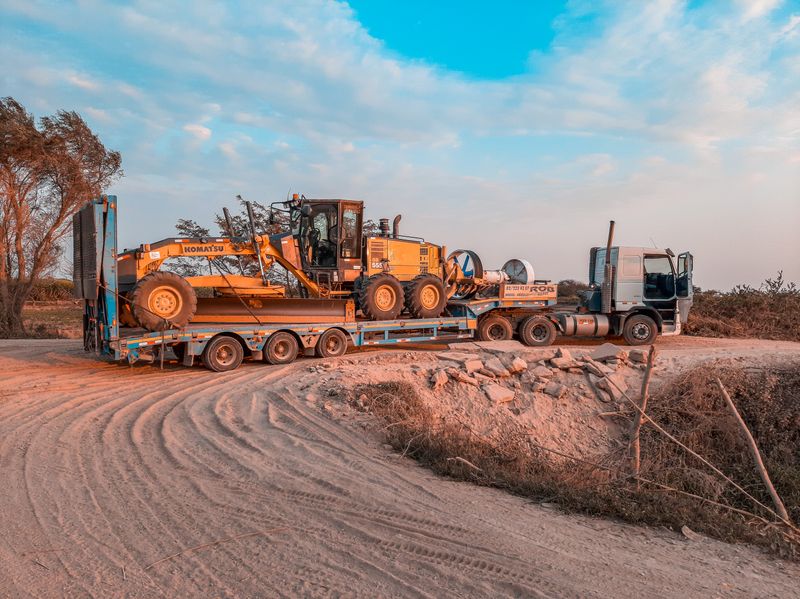
Moving heavy equipment between job sites is one of the most regulated, most expensive, and most frequently mismanaged aspects of construction operations. A 50-mile move that seems simple — load the excavator, drive to the site — can become a compliance nightmare if you’re operating an overweight or oversize load without the right permits, the right trailer, and the right equipment.
This guide covers everything you need to know about choosing the right trailer, understanding weight limits, obtaining permits, and executing equipment moves safely and legally.
Trailer Types: Matching the Trailer to the Machine
Not all trailers are created equal, and using the wrong trailer for a machine is both a safety risk and a compliance issue.
Bumper Pull / Tag-Along Trailers
- Capacity: 10,000–20,000 lbs
- Best for: Skid steers, compact track loaders, small excavators (mini class), small compactors
- Hitches: Require a 2-inch or 2-5/16-inch ball or pintle hitch on the tow vehicle
- Notes: Generally do not require a CDL if the combined vehicle weight (GCVW) stays under 26,000 lbs. Check state laws — limits vary.
Gooseneck Trailers
- Capacity: 20,000–50,000+ lbs (depending on axle count)
- Best for: Mid-size excavators (5–15 tons), backhoes, track loaders, compact wheel loaders
- Hitches: Require a gooseneck ball in the pickup bed, typically 2-5/16-inch; or a fifth-wheel on commercial trucks
- Notes: Commonly 20–40 feet long; 3-car and 4-car gooseneck trailers are the standard for most contractors hauling mid-size equipment. CDL is required when GCVW exceeds 26,000 lbs.
Flatbed Trailers (Step-Deck / Drop-Deck)
- Capacity: 40,000–48,000 lbs payload (standard 48-ft flatbed)
- Best for: Wheeled and tracked equipment that fits within standard height limits (under 8.5 ft on the deck)
- Notes: A standard flatbed deck sits approximately 55 inches off the ground. For taller equipment, a step-deck lowers the rear deck to approximately 42 inches. Widely available in commercial trucking.
Lowboy (Detachable Gooseneck / RGN) Trailers
- Capacity: 40,000–150,000+ lbs (varies significantly by axle configuration)
- Best for: Full-size excavators (20+ tons), large bulldozers, motor graders, rough terrain cranes
- Deck height: 18–24 inches off the ground — significantly lower than a flatbed, enabling taller equipment to remain within legal height limits
- Loading: The gooseneck detaches and lowers to the ground, allowing the machine to drive directly onto the deck. No ramps needed for most tracked machines.
- Notes: Requires a Class A CDL with appropriate endorsements. Operating a loaded lowboy requires significant experience — handling is very different from conventional trucks due to the low center of gravity and long wheelbase.
Multi-Axle / Modular Trailers
- Capacity: 150,000–500,000+ lbs
- Best for: Very large cranes, mining equipment, industrial machinery
- Notes: These are specialized transport requiring engineering review, route surveys, and almost always state police escorts. Not typical for most contracting operations.
Understanding Weight Limits
Federal Bridge Formula
The federal government limits gross vehicle weight (GVW) to 80,000 lbs on interstate highways for standard 5-axle combinations (three-axle tractor + two-axle trailer). This is the familiar “80,000 lb” limit you see on signs.
But individual axle weights also matter:
| Axle Type | Federal Limit |
|---|---|
| Single axle | 20,000 lbs |
| Tandem axle group | 34,000 lbs |
| Tridem axle group | 42,000 lbs (federal); varies by state |
The Bridge Formula (Formula B) adds additional restrictions to prevent concentrated loads on short wheelbase combinations. The formula: W = 500 × [(LN / N-1) + 12N + 36] where W is the allowable gross load in pounds, L is the distance in feet between the outer axles of a group, and N is the number of axles.
In practice, this means:
- Spreading your axles farther apart increases your legal payload
- Steer axle, drive axles, and trailer axles all factor in
- A permit carrier’s dispatcher calculates this for each unique load and configuration
State Variation
Every state has its own weight limits that may differ from federal standards. Some states allow higher gross weights on state routes (Texas allows up to 84,000 lbs GVWR with a road use fee; some states allow higher axle loads on non-interstate routes). When crossing state lines, you must comply with the most restrictive state in your route.
Oversize and Overweight Permits
If your load exceeds any dimensional or weight limit, you need a permit before you move. Operating without required permits exposes you to:
- Significant fines (typically $500–$5,000+ per violation depending on the state and severity)
- Vehicle out-of-service orders
- Liability in accidents involving the oversize load
- Potential CDL jeopardy for commercial drivers
What Triggers Permit Requirements
| Dimension | Threshold That Triggers a Permit |
|---|---|
| Width | Over 8 ft 6 in (102 in) |
| Height | Over 13 ft 6 in (varies by state; some allow up to 14 ft) |
| Length | Over 65–75 ft (varies by state) |
| Gross weight | Over 80,000 lbs |
| Single axle | Over 20,000 lbs |
How to Obtain Permits
Self-service (single state, standard OW/OS): Most states have online permit portals. Axle weights, dimensions, and route information go in; the permit comes out. Cost is typically $15–$75 per state for standard superloads.
Permit service (multi-state or complex loads): For loads crossing multiple states or exceeding “superload” thresholds, most operators use a permit service. Companies like Overdrive Permits, Anderson Trucking Permit Division, ProPermits, and National Permit Specialists handle all states from a single request. Permit service fees range from $50–$200+ per state depending on complexity, plus the state permit fees.
Lead time:
- Standard permits (up to 2x legal weight, modest oversize): 1–3 business days
- Complex or superloads: 5–20 business days; some require engineering review
- Emergency/same-day: Available in many states for an additional fee
Annual/Blanket Permits
Some states offer annual permits for recurring oversize moves within the state. If your operation regularly transports the same equipment type on the same corridors, an annual blanket permit is more economical than single-trip permits.
Pilot Cars and Escort Requirements
Certain load dimensions trigger pilot car (escort vehicle) requirements. Thresholds vary by state, but general patterns:
| Load Dimension | Typical Escort Requirement |
|---|---|
| Width 12–14 ft | 1 rear pilot car in most states |
| Width 14–16 ft | 1 front + 1 rear pilot car in most states |
| Width over 16 ft | State police escort often required |
| Height over 14–15 ft | Route survey required; front pilot car for overhead clearance |
| Extremely long loads | Pilot car with height pole to check bridge clearances |
Pilot car requirements:
- Vehicle must be properly equipped: sign (“OVERSIZE LOAD”), flags, amber beacon or flashing lights
- Driver must be licensed in most states (some require a pilot car certification course)
- Pilot cars must maintain appropriate following distances and communicate with the load driver
Pilot car certification: The National Oversize Transport Association (NOSTA) and some state DOTs offer certification courses. Several states now require a state-issued pilot car operator’s license.
CDL Requirements for Equipment Transport
The threshold for a Commercial Driver’s License (CDL) in the United States:
- Class A CDL required when the combination vehicle (truck + trailer) has a Gross Combined Vehicle Weight Rating (GCVWR) over 26,000 lbs AND the trailer alone has a GVWR over 10,000 lbs
- Class B CDL covers single vehicles over 26,000 lbs GVWR (less common for equipment hauling)
Agricultural exemptions: Some states have CDL exemptions for farm equipment transport within a certain radius. These apply to farming operations, not commercial contractors.
Endorsements: Hauling double trailers requires a “T” endorsement. Tank vehicles require an “N” endorsement. Most equipment transport requires only a basic Class A without additional endorsements.
Pre-Trip CDL Inspection Requirements
CDL drivers must perform a pre-trip inspection and document it. Key elements for equipment transport:
- Trailer brake connections (glad hands, brake test)
- Lights and reflectors on trailer
- Tie-down condition
- Tire condition on all trailer axles
- Coupling security (fifth wheel or gooseneck ball)
Route Planning for Oversize Loads
Routing an oversize load isn’t just about picking the shortest path. Consider:
1. Bridge weight ratings Many state and county bridges are posted with weight limits. Even if your gross weight is legal on the highway, a low-rated bridge may prohibit your load. The Federal Highway Administration (FHWA) maintains the National Bridge Inventory database. State DOT routing tools typically flag bridge restrictions automatically.
2. Overhead clearances Height permits include a route survey requirement for loads above certain heights. A route survey means physically driving the route (in a passenger vehicle) and identifying all clearances — overhead utilities, bridge trusses, signal gantries, and low branches on rural roads.
3. Turning radius and intersection constraints A 53-foot lowboy loaded with a 35-ton excavator has a very long turning radius. Rural intersections, roundabouts, and tight city blocks may be impassable. Scout tight turns before the load move if you’re unsure.
4. Time restrictions Many states restrict oversize loads to daylight hours only (typically one hour after sunrise to one hour before sunset). Weekend and holiday restrictions may also apply. Bridges, tunnels, and high-traffic corridors often have additional time windows.
Loading Safely: Best Practices
-
Use a spotter for loading and unloading. The driver cannot see the machine during loading — a ground spotter communicates position, clearance, and ramp alignment.
-
Position the heaviest end toward the front of the trailer. This keeps the load’s CG forward, reducing trailer sway and improving tractor control.
-
Center the load left-to-right. An off-center load creates uneven axle weights that may violate permit specifications and cause tire overload.
-
Lower all booms, blades, and attachments. Any projection that increases the transport height or width beyond the permitted envelope is a violation — and a hazard.
-
Engage all transport locks. Excavator swing locks, hydraulic lockout valves, boom support pins — check the operator’s manual for all transport-specific security measures.
Cost Estimating: Moving Equipment
Understanding the full cost of an equipment move helps with job bidding and rental vs. own decisions:
| Cost Element | Typical Range |
|---|---|
| Trucking rate (local, <50 miles) | $150–$400 flat rate |
| Trucking rate (highway, per mile) | $4–$10 per loaded mile |
| Lowboy day rate (rental) | $300–$600 + fuel |
| Permit fees (single state) | $25–$150 per permit |
| Pilot car rate | $100–$250 per day |
| Permit service fee | $75–$300 per move |
For a 200-mile move of a 25-ton excavator requiring a lowboy, two pilot cars, and permits in two states: budget $1,500–$3,500 all-in.
Recommended Products and Services
For owner-operators hauling their own equipment:
- Curt 17600 Air-Receiver Kit for Gooseneck Brake Activation — required for actuating trailer brakes on gooseneck trailers from a 1/2-ton or 3/4-ton pickup
- Draw-Tite Gooseneck Hitch (25,000 lb rating) — OEM-style installation for F-350 and similar; essential for pulling heavy goosenecks safely
- Reese Towpower 83660 Fifth Wheel King Pin Lock — for Class 8 combos; prevents unauthorized trailer release
For compliance and documentation:
- J.J. Keller Hours of Service Logbook — paper backup for electronic logging; required for CDL commercial drivers
- FMCSA Cargo Securement Rules Laminated Quick Reference Card — keep in the cab for roadside inspection reference
- Overdrive Permits App — simplified multi-state oversize permit application; integrates with your truck profile for automated dimension/weight calculations
Bottom Line
Heavy equipment transport is a legitimate logistics discipline with real regulatory requirements, real permit processes, and real consequences for shortcuts. The most common mistakes — wrong trailer for the machine weight, no permit for an oversize load, incorrect axle weights — are all avoidable with proper planning.
If you’re hauling regularly, build relationships with a permit service and a reliable lowboy carrier. The cost of professional logistics is small compared to the cost of fines, inspections, and the downtime that comes from being put out of service on the side of the highway.

Ironworks Insider Editorial Team
Independent trade-focused editorial team