GPS and Grade Control Systems for Heavy Equipment: A Complete Guide
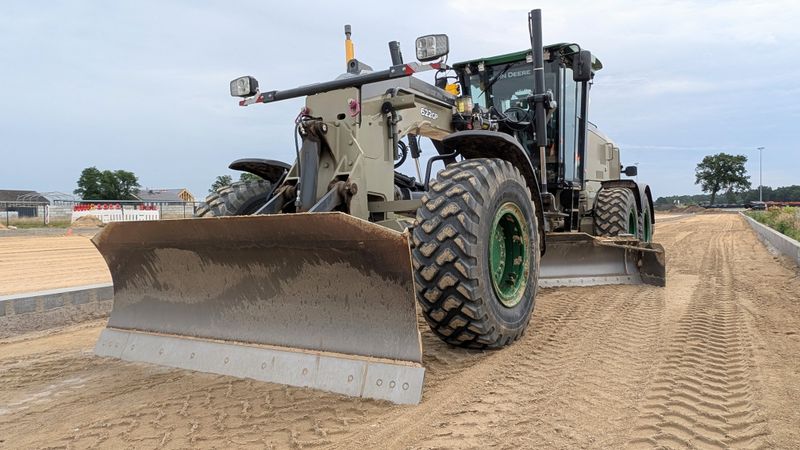
GPS grade control has transformed how earthmoving contractors work. What once required a crew of surveyors, grade checkers, and multiple passes over the same ground can now be accomplished by a single operator using real-time 3D guidance. If you’re evaluating machine control systems for your fleet — or just trying to understand what the technology does — this guide covers everything from the basics to ROI analysis.
What Is Machine Control for Heavy Equipment?
Machine control refers to technology that uses positioning data — GPS, GNSS, laser, or total station signals — to guide heavy equipment operators in achieving precise grades and elevations. The system compares the actual position of the cutting edge (blade, bucket, or drum) to the design surface and tells the operator — or in some cases, automatically moves the machine — how to achieve the target grade.
Machine control systems range from simple 2D laser receivers mounted on a motor grader to full 3D GPS/GNSS systems with automatic blade control on a dozer. Understanding the difference between 2D and 3D systems is the first step in selecting the right technology for your work.
2D vs. 3D Grade Control: What’s the Difference?
2D Grade Control Systems
A 2D grade control system works in two dimensions — it can maintain a single slope or a cross-slope, but it doesn’t know its horizontal position on the jobsite. 2D systems typically use:
- Laser levels — a rotating laser transmitter broadcasts a flat or sloped plane, and a mast-mounted receiver on the machine picks up the signal
- Sonic tracers — a sensor that follows a stringline or curb to maintain a set offset
- Cross-slope sensors — gyroscopic sensors that maintain a programmed slope without external reference
2D systems are cost-effective and work well for large paving or flatwork applications where the grade is a simple plane. They’re also commonly used for motor grader road maintenance, where the operator sets a crown slope and the blade automatically maintains it.
The limitation is that the machine doesn’t know where it is horizontally, so you still need grade stakes or a surveyor to establish reference elevations.
3D Grade Control Systems
A 3D GPS/GNSS grade control system knows both where the machine is and where it needs to be. The system uses:
- A 3D design model of the finished surface (created in CAD or site design software)
- GNSS receivers mounted on the machine (typically two for heading accuracy)
- A base station or RTK network providing centimeter-level corrections
- An in-cab display showing the cutting edge position relative to the design
With 3D grade control, the operator sees a real-time cut/fill indication on screen and can work without grade stakes. High-end systems add automatic blade control, where hydraulic valves respond to position data and move the blade without operator input — the operator steers and controls travel speed while the system handles grade.
3D systems require more upfront investment but deliver dramatically better results on complex grading work like site development, road construction, and utility trenching.
How GPS/GNSS Works on Heavy Equipment
The Signal Chain
Global Navigation Satellite Systems — including the American GPS, Russian GLONASS, European Galileo, and Chinese BeiDou — broadcast timing signals from satellites in medium Earth orbit. A GNSS receiver calculates its position by measuring the time it takes signals to arrive from multiple satellites. Standalone GNSS accuracy is typically 1–3 meters, which isn’t good enough for machine control.
To achieve centimeter-level accuracy, machine control systems use Real-Time Kinematic (RTK) correction. RTK works by placing a base station receiver at a known, surveyed point. The base station measures the difference between its known position and the GNSS-calculated position, then broadcasts correction data over a radio link or cellular network to the rover (the machine-mounted receiver). The rover applies those corrections in real time, achieving horizontal accuracy of ±1–2 cm and vertical accuracy of ±2–3 cm.
Network RTK (NTRIP)
Instead of setting up a dedicated base station, many contractors now use Network RTK services, which provide corrections via cellular data from a network of base stations. Providers like Trimble VRS Now, Leica SmartNet, and various state DOT networks offer subscription-based correction services. Network RTK eliminates the need to set up and monitor a base station, though coverage can be spotty in remote areas.
IMU Integration
Modern machine control systems add Inertial Measurement Units (IMUs) to compensate for GNSS signal loss (under trees or near buildings) and to accurately track blade position on machines with complex articulation like motor graders. IMUs measure acceleration and angular rate, bridging gaps in GNSS data.
Major Machine Control Systems
Trimble
Trimble is the dominant player in aftermarket machine control. Their product line includes:
- Trimble Earthworks — the current-generation platform for dozers, motor graders, excavators, and compactors, featuring an Android-based display and cloud connectivity
- Trimble GCS900 — the previous-generation platform, still widely deployed and supported
- Trimble Siteworks — a survey-grade rover system that can feed data to machines
Trimble has strong dealer networks and integrates tightly with Trimble Business Center office software for design file management.
Topcon
Topcon offers a competitive system with a reputation for robust hardware:
- Topcon X-53x — their flagship automatic dozer system
- Topcon X-63 — excavator guidance
- Topcon 3D-MC2 — a widely deployed previous-generation platform
Topcon’s Magnet Office software handles design preparation, and their systems support both GPS and robotic total station integration.
Leica Geosystems (Hexagon)
Leica (now part of Hexagon) is strong in surveying and has a growing machine control presence:
- Leica MC1 — their current machine control platform
- Leica iCON — designed for building construction as well as civil work
Leica systems are known for precision and integrate well with Leica survey instruments.
OEM-Integrated Systems
Several equipment manufacturers now offer factory-installed or dealer-installed machine control:
- Komatsu Intelligent Machine Control (iMC) — fully integrated on Komatsu D61/D71/D155 dozers and excavators, with semi-automatic and automatic grading modes. iMC 2.0 features auto-tilt dozing.
- CAT Grade with 3D — available on Cat D6 and D8 dozers and 140/150 motor graders, factory-integrated with the machine’s hydraulics
- John Deere SmartGrade — integrated on JD 700/750/850 dozers
OEM systems offer tighter integration with machine hydraulics and diagnostics but may lock you into that manufacturer’s software ecosystem.
Benefits of GPS Grade Control
Reduced Rework
Studies consistently show that machine control reduces rework by 20–50% on grading projects. Without grade stakes and human checkers, operators still achieve tighter tolerances — and the system catches errors in real time rather than after the fact.
Faster Production
Experienced operators running machine control systems report 15–30% faster cycle times on finish grading. The operator spends less time checking cuts manually and more time moving material efficiently.
Reduced Surveying Costs
On a traditional site job, survey crews stake the site, check grades during earthwork, and verify final grades before paving. GPS machine control dramatically reduces the number of stakes needed and allows operators to self-check, cutting surveying man-hours by half or more on many projects.
Improved Safety
Fewer grade checkers walking in front of machines means fewer opportunities for struck-by accidents — one of the leading causes of construction fatalities.
ROI Analysis: Is Machine Control Worth It?
System Costs
Aftermarket 3D dozer systems (hardware + software) typically run $25,000–$50,000 per machine for a full automatic system. Semi-automatic and indicate-only systems are less expensive. OEM-integrated systems add $15,000–$30,000 to machine purchase price.
Annual costs include: RTK corrections ($2,000–$5,000/year for network service or base station maintenance), software updates, and occasional hardware repairs.
Payback Calculation
A simple payback analysis for a dozer running machine control:
- Survey cost savings: $3,000–$8,000 per project (fewer stakes, less checking)
- Rework reduction: 1 day of rework on a mid-size site = $5,000–$15,000 saved
- Production gain: 20% faster grading on a 1,000-hour/year machine at $150/hour = $30,000 in additional revenue capacity
Most contractors report payback periods of 1–3 years on high-utilization machines. For machines working fewer than 500 hours per year, the math gets tighter — rental or dealer demonstration programs can help evaluate fit.
Installation Options: Aftermarket vs. Factory
Aftermarket Installation
Aftermarket systems are installed by authorized dealers or in-house technicians. Advantages include:
- Works on any brand/age of equipment
- Can be transferred between machines
- Independent service network
The main consideration is installation quality — mast mounting, cable routing, and hydraulic valve installation need to be done correctly for reliable performance.
Factory (OEM) Integration
Factory systems offer better integration with machine electronics, cleaner installation, and often better warranty support. The trade-off is higher per-machine cost and less flexibility if you run a mixed fleet.
Total Stations and Laser Levels as Alternatives
GPS isn’t always the right answer. In certain situations, alternative positioning methods are more appropriate:
- Rotating laser levels are excellent for flat or single-slope work (parking lots, floors, agricultural land leveling) and cost far less than GPS systems. A quality laser level and machine receiver setup runs $3,000–$8,000.
- Robotic total stations provide high accuracy (sub-centimeter) in GPS-challenged environments like urban canyons, tunnels, and indoor work. They require a line of sight between the instrument and machine prism.
- Cable-based sonic systems are reliable for utility installation and road resurfacing work.
Many contractors run a combination: GPS for complex site work, laser for flatwork paving and concrete prep.
Learning Curve and Operator Training
The technology is only as good as the operators running it. Common training challenges include:
- Understanding the design model — operators need to know how to interpret the on-screen display and recognize when something looks wrong (bad design file, base station issue, etc.)
- Calibration procedures — blade tip calibration, mast calibration, and base station setup must be done correctly
- Troubleshooting — knowing when to trust the screen and when to check with a level
Most system manufacturers offer certified training programs. Trimble, Topcon, and Leica all have dealer-based training as well as online resources. Budget 2–5 days of dedicated training per operator, plus a period of supervised operation before going independent.
Investing in a machine control-savvy grade foreman who can support multiple operators significantly multiplies the technology’s value.
The Future: Autonomous Grading
The trajectory of machine control points toward greater autonomy. Komatsu’s Smart Construction initiative, CAT’s Command for Dozing, and startup players are pushing toward machines that can grade a site with minimal operator involvement.
Current autonomous dozing systems operate within geofenced areas, following a design model without an operator in the cab. These systems are in commercial use on large mining and infrastructure projects today.
In the near term, expect:
- Tighter OEM integration — machine control increasingly standard rather than optional
- Cloud-connected design updates — design files pushed to machines from the office instantly
- As-built data capture — machines continuously recording as-built surface data for QA/QC
- AI-assisted planning — algorithms optimizing cut/fill sequences and haul routes
For contractors evaluating machine control now, the technology is proven and the ROI is real. The main question is matching the right system to your work mix and ensuring your operators are trained to use it effectively.
Getting Started
If you’re new to machine control, a practical starting path is:
- Demo before you buy — most dealers offer jobsite demonstrations; see it working on your type of work
- Start with one machine — prove the ROI on a single dozer or grader before fleet-wide rollout
- Use network RTK — avoid the base station management headache while you’re learning the system
- Invest in training — don’t skimp on operator education; it determines whether you capture the full value
The upfront investment is meaningful, but for contractors doing regular earthmoving and site grading work, GPS grade control consistently pays for itself — and typically within the first few major projects.

Ironworks Insider Editorial Team
Independent trade-focused editorial team