Mini Excavator Buying Guide: How to Choose the Right Compact Excavator
Quick answer
A mini excavator should be bought around the work envelope: dig depth, tail swing, hydraulic flow, trailer weight, attachment needs, service access, and dealer support. The right machine is the one that fits both the site and transport plan.
Common questions
- What matters most when buying a mini excavator?
- Match operating weight, dig depth, reach, bucket breakout, hydraulic flow, tail swing, cab options, and attachment compatibility to the jobs you actually do.
- Why does dealer support matter?
- Parts availability, service response, warranty support, rental backup, and technician familiarity can matter as much as the spec sheet when the machine is down.
Source note: Reviewed July 2026 against OSHA construction-equipment rules, AEM compact-equipment safety materials, and manufacturer compact-excavator spec guidance from Cat and Bobcat. Manufacturer manuals, site plans, transport laws, and competent-person direction control field work.
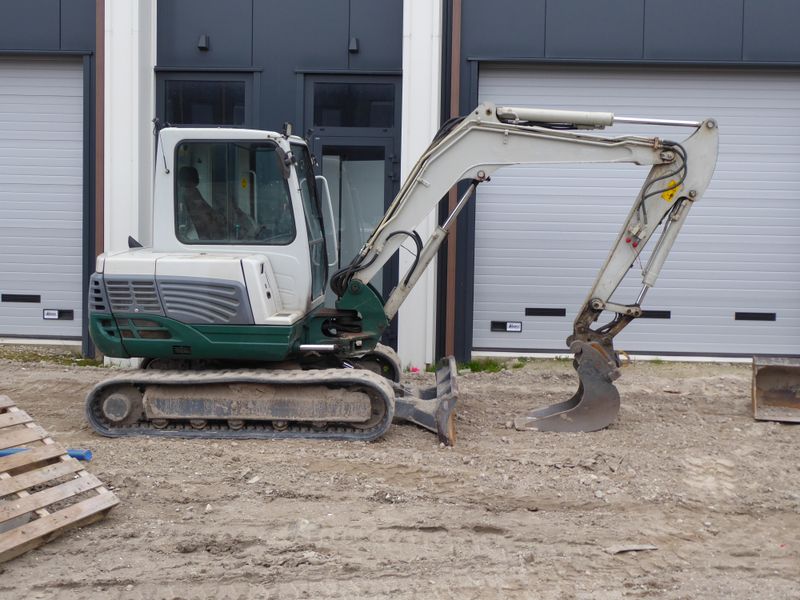
Mini excavators are popular because they put real digging capability into residential yards, utility corridors, landscape jobs, and small commercial sites where a full-size excavator cannot work. A compact excavator in the 1–6 ton range can dig a trench, remove a stump, place drainage pipe, or prep footings without taking over the entire site.
But “mini excavator” covers a wide range of machines — from 2,000 lb micro-diggers you can haul in a pickup bed to 13,000 lb units that approach full-size excavator capability. Choosing the wrong size, configuration, or brand for your needs can cost you serious money in lost productivity, repair bills, or a machine that can’t do the job.
This guide covers everything you need to make a smart purchase or rental decision.
Mini Excavator Fit Scorecard
Score the machine against the job before comparing brands:
| Fit factor | Green light | Yellow light | Red light |
|---|---|---|---|
| Access width | Machine and trailer fit gates, alleys, and ramps with margin | Retractable undercarriage or temporary fence removal needed | Machine cannot enter without damage or unsafe backing |
| Dig depth and reach | Common trench/foundation depth is inside comfortable working range | Depth is possible only at full extension | Machine cannot reach target depth or spoil location |
| Tail swing | Reduced or zero tail swing matches walls, fences, and traffic | Conventional swing works only with spotter and clear exclusion zone | Counterweight enters pedestrian, traffic, or structure space |
| Auxiliary hydraulics | Flow, pressure, couplers, and controls match planned attachments | One attachment needs optional circuit or coupler changes | Hammer, auger, thumb, or tilt bucket cannot run correctly |
| Transport | Tow vehicle, trailer, tie-downs, and route are legal with attachments | Payload is close after bucket/thumb/extra fuel | Combined weight exceeds rating or requires permits you do not have |
| Service support | Dealer stocks filters, wear parts, tracks, pins, and hoses | Parts are available but slow | Dealer support is too thin for downtime-sensitive work |
OSHA construction rules for material handling equipment and general equipment requirements such as blocked/secured raised equipment in 1926.600 are a baseline, not a complete operator manual. AEM’s safety materials are also worth keeping with operator onboarding and daily inspection paperwork.
Who Should Rent, Buy Used, or Buy New?
| Buyer profile | Best path | Why |
|---|---|---|
| Homeowner with one drainage or stump project | Rent with delivery | Ownership, insurance, storage, and transport rarely make sense |
| Landscaper using a machine every few weeks | Rent first, then model utilization | Real job hours prove whether purchase payments are justified |
| Contractor using the machine weekly | Used or new purchase | Availability and attachment familiarity can beat rental flexibility |
| Utility or production crew with downtime penalties | New or late-model used with dealer support | Warranty, telematics, parts priority, and service response matter |
| Attachment-heavy operator | Spec around hydraulics before brand | Flow, pressure, couplers, and proportional controls decide productivity |
Use the equipment ownership cost calculator before treating a monthly payment as the full cost. Include trailer, tie-down gear, insurance, fuel, tracks, pins and bushings, fluid service, hydraulic hoses, downtime, and resale assumptions.
What Counts as a Mini Excavator?
The industry generally defines mini (or compact) excavators as machines in the 1–10 metric ton operating weight class. The most common residential and light commercial sizes are 1.5–5 tons. Machines in the 6–10 ton range blur into conventional (full-size) excavator territory.
Mini excavators share the same basic layout as their larger cousins — a rotating upper structure with a boom, arm, and bucket; rubber or steel tracks; and an operator cab or canopy — but in a package designed to work in tight spaces.
Key Specifications Explained
Before comparing models, understand what the specs actually mean for your work.
Operating Weight
This is the weight of the machine with standard equipment, full fluids, and no attachments. It determines what trailer you need for transport, how much ground bearing pressure the machine exerts (important on soft or finished surfaces), and how the machine handles on slopes.
Maximum Dig Depth
How deep the machine can dig with the arm fully extended. A 3-ton machine typically digs 8–10 feet deep. A 5-ton machine reaches 12–14 feet. Match this to your application — utility trenching, foundation work, or landscaping have very different depth requirements.
Tail Swing
This is the critical spec that determines where a mini excavator can work.
- Conventional tail swing: The counterweight extends significantly beyond the track width when the machine rotates. Requires clear space around the machine to swing safely.
- Reduced tail swing: The counterweight extends slightly beyond the tracks.
- Zero tail swing (ZTS): The counterweight stays within or very near the track footprint during rotation. Essential for working along fences, walls, building foundations, or inside structures.
Zero tail swing machines are more versatile for tight-space work but typically cost 5–10% more and may carry slightly less counterweight, affecting lift capacity.
Bucket Breakout Force
Measured in pounds or kilonewtons, this is the force the bucket can exert during a digging curl. Higher breakout force means better performance in hard clay, compacted soil, or rocky ground. Compare this spec when working in challenging conditions — it varies significantly between machines of the same weight class.
Auxiliary Hydraulic Flow
If you plan to run attachments — hydraulic thumbs, augers, plate compactors, mulching heads, tilting buckets — check the machine’s auxiliary hydraulic flow rate (gallons per minute) and pressure (psi). Attachments have minimum flow requirements, and a machine with insufficient flow will run them slowly or not at all. High-flow auxiliary systems are available on many mini excavators as options and are worth specifying if attachment use is in your plans.
Bobcat’s compact excavator buyer guidance calls out hydraulic flow and pressure as key attachment-performance inputs, and Cat’s compact excavator model pages show why spec sheets matter: machines close in name can differ meaningfully in operating weight, dig depth, hydraulic flow, and tail swing. Use manufacturer spec pages to compare the exact model and stick/track/cab configuration, not only the series name.
Top Brands in the Mini Excavator Market
Kubota
Kubota is the dominant brand in the mini excavator segment in North America, particularly in the 1.5–5 ton range. Their KX series (KX033, KX040, KX057) and U series (zero tail swing) machines are widely regarded as the most refined compact excavators on the market. Kubota KX and U series machines are known for excellent hydraulic feel, solid build quality, and strong dealer support. Parts availability is excellent and resale value is strong.
Best for: Contractors and landscapers who want a refined, reliable workhorse with outstanding dealer coverage.
Caterpillar (CAT)
CAT’s 300 series mini excavators (CAT 301, 302, 305, 308) bring the CAT brand’s legendary dealer network and parts availability to the compact segment. The CAT 305 and 308 are particularly well-regarded as versatile, capable machines. CAT’s Grade technology integration and telematics (via Cat App) are strong differentiators for technology-forward operations.
Best for: Contractors already in the CAT ecosystem who value best-in-class dealer support and resale value.
Bobcat
Bobcat’s mini excavators (the E series — E20, E35, E50, E60, E85) are popular, particularly among contractors who already run Bobcat skid steers and want a unified dealer relationship and attachment interoperability where possible. The Bobcat E35 and E50 are especially popular mid-range models. Build quality and performance are competitive. Bobcat’s attachment ecosystem is broad.
Best for: Contractors with existing Bobcat equipment looking for a single-brand solution.
John Deere
Deere’s 17G, 26G, 35G, 50G, 60G series brings strong rural dealer coverage and John Deere Financial financing options to the segment. The 35G and 50G are capable, well-equipped machines. Deere’s JDLink telematics and SmartGrade machine control (on larger units) are competitive. Particularly strong for contractors in agricultural markets who already have Deere relationships.
Best for: Contractors in rural markets with existing Deere dealer relationships.
Komatsu
Komatsu’s PC26, PC35, PC55, PC78 compact excavators are respected for Komatsu’s hydraulic engineering and fuel efficiency. Less common than Kubota or CAT in the North American compact segment, but solid machines with good performance. Dealer coverage is thinner in rural markets.
Best for: Contractors in markets with strong Komatsu coverage who prioritize hydraulic performance.
What Size Do You Need?
| Application | Recommended Size |
|---|---|
| Landscaping, small trenching, tight residential | 1.5–3 ton |
| General contractor use, utility work, moderate digging | 3–5 ton |
| Foundation work, heavier earthmoving, attachments | 5–8 ton |
| Approaching full-size excavator capability | 8–10 ton |
If you’re working primarily inside buildings, near walls, or in fenced yards, zero tail swing is not optional — it’s a requirement. Budget accordingly.
New vs. Used Mini Excavators
New machines offer warranties (typically 2–3 years), the latest technology, dealer financing, and no maintenance history surprises. Expect to pay $40,000–$100,000+ depending on size and configuration.
Used machines offer significant cost savings — well-maintained used Kubota and CAT mini excavators regularly sell at 60–70% of new price with 2,000–4,000 hours. Key inspection points for used machines:
- Undercarriage wear — tracks, rollers, sprockets, and idlers are major expense items. Check wear percentages.
- Boom and arm pins and bushings — worn pins cause slop and reduced digging precision.
- Hydraulic cylinder seals — look for seeping or weeping around cylinder rods.
- Telematics records — if the machine has telematics data, review idle percentage and fault history.
- Service records — regular oil and filter changes are table stakes; verify them if possible.
For used machines, an inspection by an independent diesel mechanic or equipment dealer technician is money well spent before a purchase.
Rental vs. Buying
If your mini excavator use is project-specific or infrequent, rental is almost always the smarter financial decision. National rental chains (United Rentals, Sunbelt, H&E Equipment) and local independents offer mini excavators by the day, week, or month.
Rent when:
- You use a mini excavator fewer than 100 hours per year
- Your work doesn’t justify owning, insuring, and maintaining a machine
- You need a size or configuration you don’t own for a specific job
Buy when:
- You use a mini excavator consistently throughout the year
- Rental availability in your market is unreliable for your schedule
- You need specific attachments that rental yards don’t stock
- The machine is central to your business model and daily production
Transport and Towing
Most mini excavators in the 1.5–5 ton range can be transported on a 10,000–14,000 lb tilt deck or equipment trailer pulled by a 3/4-ton or 1-ton pickup. Confirm the trailer’s rated capacity exceeds the machine’s operating weight with margin for attachments and any added ballast.
Machines above 5 tons typically require a heavy-duty gooseneck trailer and a capable tow vehicle — often a 1-ton dually or larger.
Check your state’s towing regulations. Many states allow single-vehicle towing configurations for compact equipment without a commercial driver’s license, but weight limits and permit requirements vary.
Making the Final Decision
Before buying, do three things:
-
Demo the machine in your actual working conditions. Run it in the soil type, access conditions, and application you’ll encounter. Hydraulic feel, visibility, and cab comfort are impossible to evaluate on a spec sheet.
-
Talk to your local dealer about parts lead times and service scheduling. A great machine with a weak local dealer is a liability. The machine you can get serviced fastest when it goes down is often the right choice.
-
Run a total cost of ownership analysis. Include purchase price or financing cost, expected maintenance (budget 5–8% of purchase price annually for well-maintained machines), insurance, transport, and projected resale value at your planned trading horizon.
-
Write down the no-buy conditions. Walk away if the undercarriage is undocumented, the boom/arm has excessive slop, hydraulic oil looks contaminated, fault codes are hidden or unexplained, serial numbers do not match paperwork, or transport math only works by ignoring attachments.
The right mini excavator is the one that fits your most common application, your access constraints, your transport capability, your attachment plan, and your dealer relationship — not necessarily the one with the best spec sheet numbers.
Model compact excavator ownership before choosing a brand
These resources connect compact-excavator specs with inspection, transport, financing, maintenance, and rent-vs-buy math.
- Equipment ownership cost calculator
Compare utilization, financing, maintenance, downtime, transport, and resale assumptions.
- How to inspect a used excavator
Check pins, bushings, undercarriage, hydraulics, leaks, and service records before buying used.
- Excavator sizes explained
Compare mini, midi, and full-size classes before narrowing weight range.
- Excavator attachments
Match hydraulic flow, couplers, controls, and attachment requirements to the machine.
- Equipment rental vs. buy
Decide whether job hours and downtime exposure support ownership.
- Equipment transport guide
Check trailer, tow vehicle, route, tie-down, and permit constraints before buying.
- Equipment maintenance reserve planner
Plan repair reserves and downtime risk before choosing a compact excavator to own.

Ironworks Insider Editorial Team
Independent trade-focused editorial team