Types of Cranes in Construction: A Complete Guide
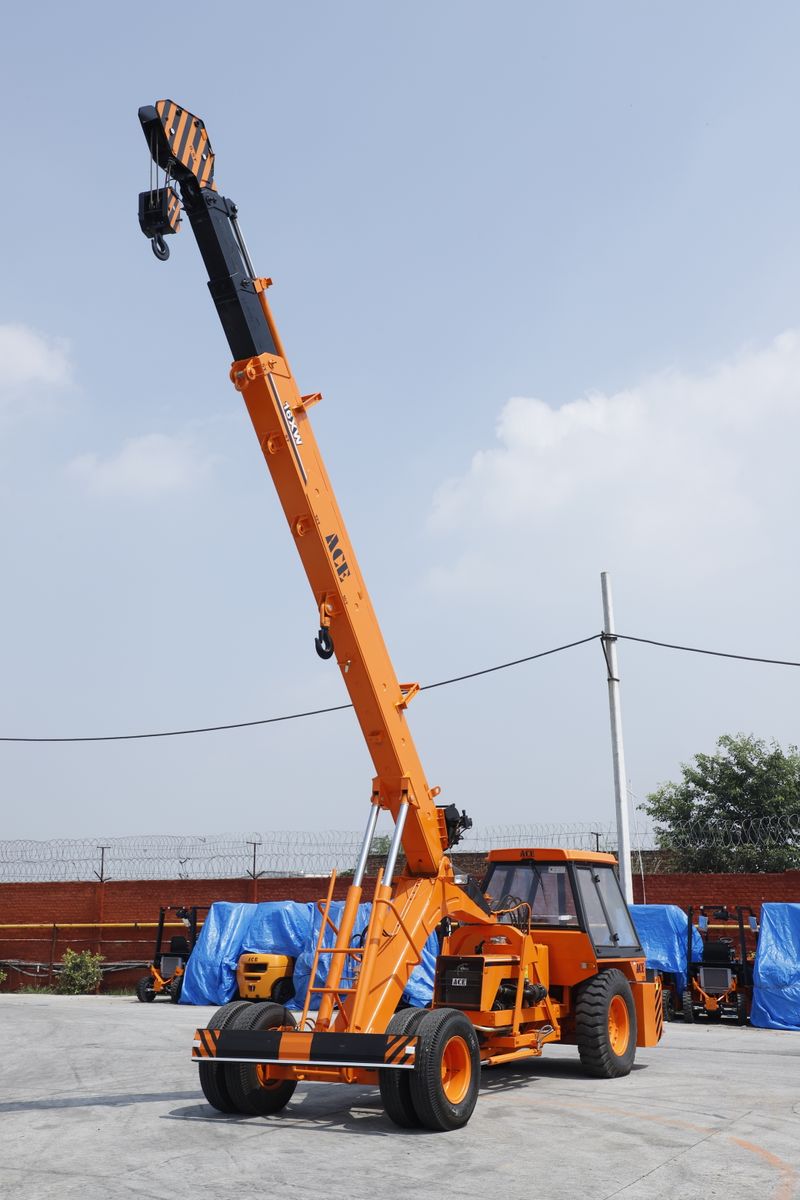
Whether you’re erecting a high-rise in downtown Manhattan or setting structural steel on a remote industrial site, choosing the right crane is one of the most consequential decisions on any project. The wrong crane choice means schedule delays, budget overruns, and potential safety hazards. The right choice means efficient, safe lifts that keep your job moving.
This guide covers every major type of crane used in construction today — how each one works, what it can lift, where it shines, and where it falls short. We’ll close with a practical selection guide to help you match the crane to the job.
Tower Cranes
Tower cranes are the defining silhouette of large-scale urban construction. Anchored to a concrete foundation or climbing up the building’s core, these machines provide unmatched height and horizontal reach for high-rise, bridge, and large commercial projects.
How Tower Cranes Work
A tower crane consists of a vertical mast, a horizontal jib (working arm) that carries the load, and a counter-jib with counterweights on the opposite side. A trolley travels along the jib to position loads horizontally, while a hook block provides vertical movement. Most tower cranes are self-erecting or erected by mobile crane and can climb vertically as the building rises around them.
Lifting capacity: 3 to 20+ metric tons, depending on configuration and radius. Capacity decreases as radius increases — always consult the load chart.
Fixed Tower Cranes
Fixed (or static) tower cranes are bolted to a permanent concrete foundation. They’re the workhorses of high-rise residential and commercial construction.
- Typical applications: Multi-story buildings, bridges, large commercial structures
- Key advantages: High stability, large working radius (up to 80+ meters), continuous 360° slew
- Limitations: Requires engineered foundation, slow to erect and dismantle, not easily relocated
Climbing Tower Cranes
Climbing cranes are initially anchored externally or built into the structure’s core. As the building rises, the crane climbs — either internally through the floor slabs or externally along the building face.
- Typical applications: Supertall buildings, cores-first construction sequences
- Key advantages: Grows with the building, frees up ground space, no mast height limitation
- Limitations: Complex climbing operations, requires careful coordination with structure sequence
Luffing Jib Tower Cranes
Where standard flat-top and hammerhead cranes swing a horizontal jib, luffing jib cranes raise and lower the jib angle. This dramatically reduces the crane’s footprint when parked.
- Typical applications: Tight urban sites with multiple cranes, proximity to air traffic zones
- Key advantages: Minimum swing radius in parked position, reduces crane interference on multi-crane sites
- Limitations: More complex operation, generally lower capacity than flat-top equivalent
Mobile Cranes
Mobile cranes are ground-based machines that travel on rubber tires or crawlers and don’t require a permanent foundation. They’re the most versatile crane category, covering everything from small pick-and-carry lifts to some of the largest lifts in the world.
All-Terrain Cranes
All-terrain cranes combine highway speed (traveling on public roads under their own power) with genuine off-road capability. They’re the most common type of mobile crane for construction and industrial work.
- Lifting capacity: 40 to 1,200+ metric tons
- Typical applications: Industrial plant maintenance, petrochemical, power generation, infrastructure, bridge erection
- Key advantages: Road legal, fast mobilization, excellent outrigger spread, available in a huge capacity range
- Limitations: Setup time for outriggers, requires firm ground under outrigger pads, requires licensed driver/operator
Rough Terrain Cranes
Rough terrain cranes ride on large pneumatic tires driven by a four-wheel-drive system. They’re designed to operate directly on the jobsite without road travel.
- Lifting capacity: 15 to 165 metric tons
- Typical applications: Construction sites, oil and gas, power line work, infrastructure
- Key advantages: Excellent on soft and uneven ground, compact footprint, easy to operate on site
- Limitations: Not road legal (must be transported by lowboy), single engine shared between travel and hoisting, shorter boom length than all-terrain
Truck-Mounted Cranes
A truck-mounted crane is a crane superstructure mounted to a standard commercial truck chassis. Also called a “boom truck,” these are the workhorses of material delivery, sign installation, and light-to-medium construction lifts.
- Lifting capacity: 3 to 50 metric tons
- Typical applications: Material placement, sign/light pole installation, HVAC equipment, utility work
- Key advantages: Road legal, arrives at the jobsite as its own transport, fast setup, lower cost than larger cranes
- Limitations: Lower capacity than dedicated mobile cranes, outrigger footprint can be an issue on tight sites
Crawler Cranes
Crawler cranes travel and operate on two parallel track systems instead of tires, distributing their enormous weight over a large footprint. They’re the choice for the heaviest lifts in the most demanding conditions.
How Crawler Cranes Work
The undercarriage consists of two steel track assemblies driven by hydraulic or mechanical drive systems. The superstructure above rotates 360° and carries a lattice boom, which can be configured with luffing jibs, fixed jibs, and other attachments to reach extreme heights.
Lifting capacity: 40 to 3,500+ metric tons (the largest crawler cranes in the world can lift over 5,000 metric tons in heavy-lift configurations).
- Typical applications: Power plant construction, refinery heavy lifts, offshore platform modules, large bridge components, stadium roof structures
- Key advantages: Massive capacity, can travel with load (pick-and-carry), excellent stability on soft ground, no outriggers required
- Limitations: Slow travel speed, must be transported by multi-axle lowboy trailers, assembly/disassembly takes significant time and additional cranes
Overhead / Bridge Cranes
Overhead cranes (also called bridge cranes run on elevated rails mounted to the walls or columns of a building. Unlike all other crane types, they don’t use a vertical mast or boom — the load travels horizontally on a bridge beam and vertically on a hoist trolley.
How Overhead Cranes Work
Two parallel runway rails are mounted along the length of a bay. The bridge (a structural beam) spans between the rails and travels along them. A hoist and trolley ride along the bridge, allowing the hook to reach any point within the rectangular coverage area.
Lifting capacity: 1/4 ton to 600+ tons, depending on design and runway structure.
- Typical applications: Manufacturing plants, steel mills, fabrication shops, warehouses, shipyards
- Key advantages: Covers the full footprint of the bay, frees up floor space, continuous duty cycles, high precision placement
- Limitations: Fixed to a building structure, no outdoor use without special design, high installation cost
For shops that need to add or upgrade overhead crane capability, hoists from trusted manufacturers such as CM Columbus McKinnon or Harrington Hoists are industry standards. A quality wire rope hoist rated for your application is one of the most important investments in any fabrication shop.
Gantry Cranes
Gantry cranes are essentially overhead cranes that support themselves on legs running on ground-level rails or rubber tires, rather than mounting to a building structure.
Types of Gantry Cranes
- Full gantry: Both ends supported by legs running on rails
- Semi-gantry: One end rides a wall-mounted rail, one end rides a floor rail
- Portable gantry: Adjustable-height, rubber-tired units for shop use or maintenance
Lifting capacity: 1 ton (portable shop models) to 1,000+ tons (shipyard or precast yard gantries).
- Typical applications: Shipyards, precast concrete yards, container terminals, outdoor maintenance yards, fabrication shops
- Key advantages: No building structure required, some models are rail-free and rubber-tired, portable gantries offer extreme flexibility
- Limitations: Limited to the gantry’s rail span and runway length, large gantries are expensive infrastructure investments
Telescopic / Boom Trucks
Telescoping boom cranes — often called boom trucks or knuckle boom trucks depending on configuration — are truck-mounted cranes where the boom sections slide in and out hydraulically to change length and reach.
Straight Boom vs. Knuckle Boom
- Straight (telescoping) boom trucks: Boom extends straight outward and up, similar in operation to a small mobile crane. Best for material placement and construction lifts.
- Knuckle boom trucks: The boom articulates at a mid-point joint, allowing the tip to fold back over the truck. Ideal for crane trucks that also need to self-load and unload in tight spaces. Common in material delivery and recycling.
Lifting capacity: 3 to 50 metric tons, depending on boom length and configuration.
- Typical applications: Material deliveries, sign and light installation, tree service, utility work, small construction lifts
- Key advantages: Arrives under its own power, no additional transport cost, fast setup (5–15 minutes), wide availability
- Limitations: Capacity limited by truck chassis stability, shorter boom than dedicated mobile cranes
Specialty Cranes
Beyond the main categories, several specialty crane types serve specific industries:
- Floating cranes: Cranes mounted on barges or vessels for marine construction, salvage, and offshore work
- Railroad cranes (Derrick cars): Mounted on rail cars for track maintenance and wreck recovery
- Aerial work platforms with crane attachments: For light utility and maintenance work
- Stacker cranes: Automated warehouse cranes that retrieve pallets from narrow-aisle racking
Crane Selection Guide
Choosing the right crane comes down to answering these key questions:
1. What is the load weight and dimensions?
Start with the heaviest single lift on the job. Add rigging weight (slings, shackles, spreader bars) to get your gross load. Never approach the maximum rated capacity — a 10–20% safety margin is standard practice.
2. What is the required radius and height?
Determine how far horizontally the crane must reach and how high the load must travel. These two numbers — combined with the load weight — are the fundamental inputs to any load chart.
3. What are the site conditions?
- Soil bearing capacity: Mobile cranes on outriggers and tower cranes on foundations require engineered ground support. Soft or unstable soils may require crane mats or piling.
- Site access: Can a large crane transport be routed to the site? Are there overhead power lines, existing structures, or trees limiting the swing area?
- Space constraints: Tight urban sites may require a luffing jib tower crane instead of a flat-top.
4. How long is the crane needed?
- Single day to a few weeks: Mobile crane rental is usually most cost-effective
- Months to years: Tower crane erection cost amortizes over a long project; may be cheaper than repeated mobile crane mobilizations
- Permanent ongoing operations: Overhead crane or gantry crane for manufacturing/fabrication
5. Indoor or outdoor?
Overhead cranes and gantry cranes are typically the best solution for indoor manufacturing environments. Mobile and tower cranes are almost exclusively outdoor equipment.
Quick Reference: Crane Type Comparison
| Crane Type | Typical Capacity | Best For | Key Limitation |
|---|---|---|---|
| Tower Crane (Fixed) | 3–20 t | High-rise buildings | Slow erect/dismantle |
| Tower Crane (Climbing) | 3–20 t | Supertall buildings | Complex sequence |
| Tower Crane (Luffing Jib) | 3–16 t | Tight urban sites | Lower capacity |
| All-Terrain Mobile | 40–1,200 t | Industrial, infrastructure | Outrigger ground prep |
| Rough Terrain Mobile | 15–165 t | Construction sites | Not road legal |
| Truck-Mounted / Boom Truck | 3–50 t | Material placement | Lower capacity |
| Crawler Crane | 40–3,500 t | Heaviest lifts | Slow, complex transport |
| Overhead / Bridge Crane | 0.25–600 t | Factories, shops | Fixed to building |
| Gantry Crane | 1–1,000 t | Yards, shipyards | Rail/runway required |
Essential Gear for Crane Operations
Safe crane operation requires more than just the right machine. Every rigging crew should be equipped with proper PPE and tools:
- Hard hat (ANSI Type II): Protect against falling objects in the work zone. Look for Class E (electrical) rating on most industrial sites.
- High-visibility vest (ANSI 107 Class 2/3): Essential for signal persons and ground crew.
- Tagline: A simple but critical tool for controlling load swing. Natural fiber or synthetic rope, typically 1/2” to 3/4” diameter.
- Load cells and dynamometers: A wireless digital load cell lets you verify actual load weight before committing to a lift — a valuable safety tool.
- Rigging inspection tools: Rigging hardware inspection kits including go/no-go gauges for shackle pins help identify worn or out-of-tolerance hardware before it’s put in service.
Final Thoughts
Understanding the full range of construction crane types is foundational knowledge for any project manager, superintendent, rigging engineer, or crane operator. No single crane type dominates all situations — the right choice depends on load, radius, site access, duration, and budget.
When in doubt, consult a licensed crane rental company or a rigging engineer. The cost of an engineering consultation is trivial compared to the cost of a crane accident or a project delay caused by the wrong equipment choice.
Stay safe, plan your lifts, and never skip the load chart.

Ironworks Insider Editorial Team
Independent trade-focused editorial team