Wheel Loader Buying Guide: How to Choose the Right Size and Brand
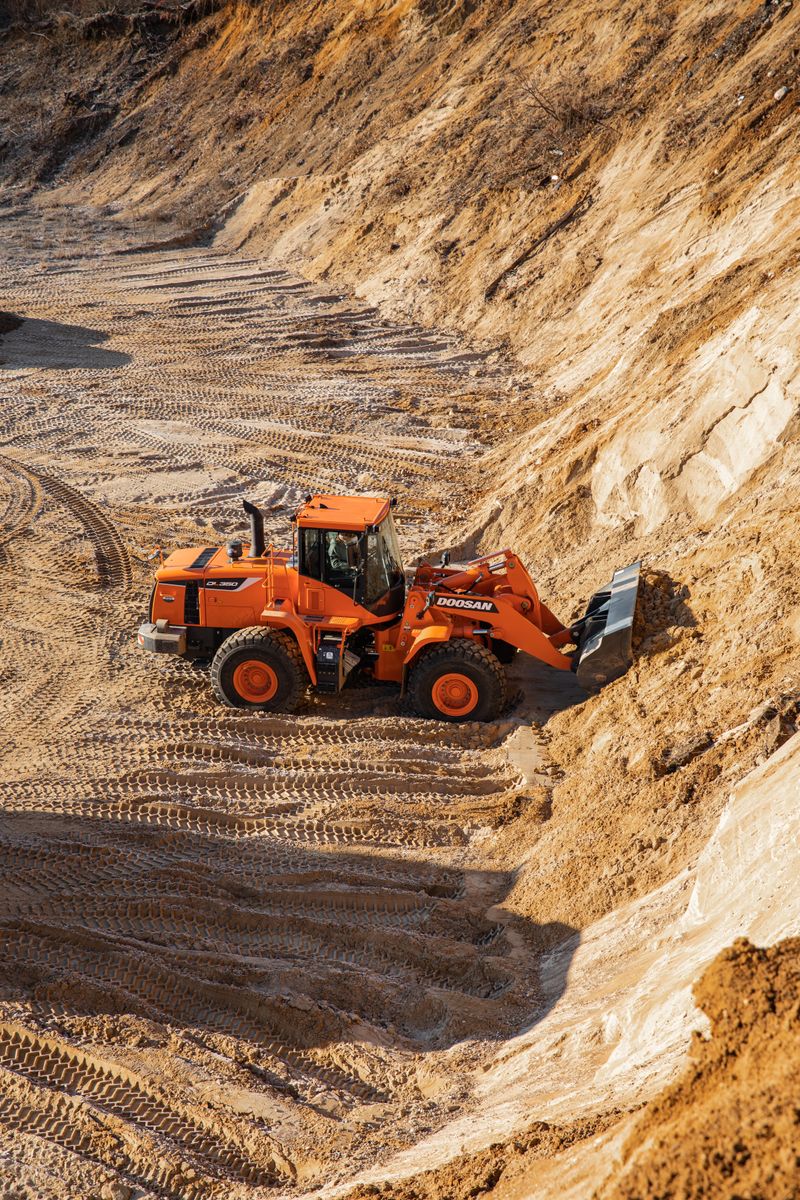
Wheel loaders move more material per hour than almost any other piece of construction equipment. On job sites ranging from highway construction to quarries to snow removal operations, a well-matched wheel loader is one of the most productive assets in a fleet. It’s also one of the most expensive — new machines start around $60,000 for compact models and exceed $400,000 for large-class units.
Getting the size, configuration, and brand right matters. Too small and you’re making twice as many passes; too large and you’re paying for capacity you’ll never use. This guide walks through everything you need to make a confident purchase decision.
What Wheel Loaders Are Used For
Wheel loaders are four-wheel-drive machines with an articulated frame and a front-mounted bucket. The articulating center joint allows tight turning in confined areas despite the machine’s size.
Common applications include:
- Stockpile management — moving aggregate, sand, gravel, or mulch from storage piles into trucks or feed hoppers
- Load and carry operations — picking up material and transporting it across a site
- Site prep and grading — light grading and surface preparation
- Snow removal — clearing roads, lots, and runways at scale
- Quarry and mining support — feeding crushers and loading haul trucks
- Agriculture — handling silage, manure, grain, and feed
The wheel loader’s greatest strengths are speed, mobility, and cycle time. On hard surfaces, a wheel loader covers ground and makes passes far faster than a tracked machine.
Size Classes: Matching the Machine to the Job
Wheel loaders are sold across a wide range of sizes. Understanding the class system helps narrow the field.
| Class | Operating Weight | Bucket Capacity | Typical Application |
|---|---|---|---|
| Compact | Under 10,000 lb | 0.5–1.0 yd³ | Landscaping, small sites, tight spaces |
| Small | 10,000–25,000 lb | 1.0–2.0 yd³ | Light construction, rental yards, municipalities |
| Medium | 25,000–50,000 lb | 2.0–4.0 yd³ | General contracting, road construction, aggregates |
| Large | 50,000–100,000 lb | 4.0–7.0 yd³ | Quarries, mines, heavy earthmoving |
| Extra Large | 100,000 lb+ | 7.0 yd³+ | Mining, large-scale earthmoving |
For most general contractors, municipalities, and aggregate operations, medium-class loaders (the CAT 950, Komatsu WA380, Volvo L90) represent the sweet spot — capable enough for serious production, manageable to transport, and with the broadest selection of new and used machines available.
Key Specifications Explained
Bucket Capacity and Rated Operating Payload
Bucket capacity (in cubic yards) tells you how much material the machine can physically carry in the bucket. Rated operating payload (ROP) tells you how much it can safely lift — a more reliable performance metric than rated capacity alone. Always check the payload rating for your material density. Dense materials like wet sand or gravel can fill a bucket to hydraulic capacity well before reaching volumetric limits.
Tipping Load and Static Tipping Load
Full-turn tipping load is the weight at which the front axle lifts off the ground when the loader is turning with a full bucket. Manufacturers typically rate operating capacity at 50% of full-turn tipping load. A machine with a 20,000 lb full-turn tipping load has a rated operating capacity of approximately 10,000 lb — know the relationship.
Breakout Force
Higher breakout force means the machine can dig into harder, more compacted material. Critical for applications involving packed aggregate or hard soil. Compare breakout force when evaluating machines for stockpile face work or bank loading.
Transmission and Drivetrain
Most modern wheel loaders use fully automatic powershift transmissions with multiple forward and reverse speeds. Look for lock-up torque converter features — they reduce fuel consumption and heat buildup during high-speed load-and-carry operations. Some manufacturers offer hydrostatic transmissions in smaller machines, which can be smoother and more fuel-efficient in short cycle applications.
Top Brands in the Wheel Loader Market
Caterpillar (CAT)
CAT’s wheel loader lineup — from the 906 compact through the 990 large — is the most recognized in North America. The 950 and 966 are among the best-selling mid-size loaders on the continent. CAT’s Integrated Payload with on-board weighing, robust dealer network, and strong resale value make them a reliable choice across the board.
Best for: Operations prioritizing parts availability, resale value, and the largest North American dealer footprint.
Komatsu
Komatsu’s WA series (WA270, WA380, WA470, WA600) are mature, well-engineered machines respected for fuel efficiency and hydraulic precision. The WA380 competes directly with the CAT 950 and is often the choice for operations where fuel cost is a primary concern. Komatsu’s KOMTRAX telematics and excellent factory build quality make these machines strong performers in high-hour applications.
Best for: High-hour, fuel-sensitive operations in markets with strong Komatsu dealer coverage.
Volvo Construction Equipment
Volvo CE’s L-series (L60, L90, L110, L150, L180, L220) are distinctive for their load-sensing hydraulic systems and outstanding operator comfort. Volvo loaders are well-regarded in the aggregate and quarry sector, and the brand has made significant inroads in the North American market. The OptiShift drivetrain with reversing fan and lock-up converter is a genuine fuel efficiency differentiator.
Best for: Aggregate, quarry, and snow removal applications where cycle time and operator comfort drive productivity.
John Deere
Deere’s 644, 724, 744, 824, 844 series covers the full range from compact to large. The 644 and 724 are popular in construction and municipal markets, backed by Deere’s rural dealer network. Deere’s PowerQuad transmission and JDLink telematics are solid. Pricing is competitive and financing through John Deere Financial is straightforward.
Best for: Contractors in rural markets with existing Deere relationships and access to Deere Financial programs.
Case Construction Equipment
Case’s 921, 1021, 1121 series offers competitive specs at pricing that typically undercuts CAT and Komatsu. Case’s PowerBoost feature automatically delivers maximum power and torque in load-demanding situations. A strong value proposition for operations where purchase price sensitivity is high and dealer coverage is available.
Best for: Cost-conscious buyers in markets with reliable Case dealer support.
Attachments: Extending Versatility
A wheel loader’s utility multiplies significantly with the right attachments. Most medium and large loaders use a quick coupler system that allows attachment changes in under five minutes.
Key attachments to consider at purchase:
- General purpose buckets — for mixed material, fill, and site work
- Light material/rock buckets — higher-volume for light materials or reinforced for abrasive applications
- Pallet forks — convert the loader into a rough terrain forklift
- Snow pushers and blades — essential for municipal and airport applications
- Log grapples — for forestry and waste handling
- Brooms and sweepers — for road maintenance and site cleanup
Specify the quick coupler system at time of purchase — retrofitting is possible but adds cost.
New vs. Used: The Financial Reality
New machines come with full manufacturer warranties (typically 2–3 years or 3,000–5,000 hours), the latest technology, and no maintenance history unknowns. Expect to pay a premium — and expect strong depreciation in the first three years.
Used machines offer significant cost savings. A well-maintained mid-size loader with 4,000–8,000 hours typically sells at 50–65% of its new price. Key inspection points:
- Tire wear — tires on a mid-size loader cost $5,000–$15,000 per set to replace
- Hydraulic cylinders and hoses — look for weeping seals around tilt and lift cylinder rods
- Loader arm pivot pins and bushings — worn pins cause slop and imprecise bucket control
- Transmission behavior — shift through all ranges; hesitation or hard shifts signal wear
- Frame cracks — inspect the articulation joint and loader arm mounting points carefully
- Telematics data — review fault history and idle percentage if the machine has a telematics subscription on record
An independent inspection by a diesel mechanic or dealer technician before purchase is worth every dollar on machines above $40,000.
Total Cost of Ownership
Purchase price is only part of the calculation. For medium-class loaders running 1,500–2,000 hours per year, budget:
- Fuel: 3–6 gallons per hour depending on application intensity and model
- Maintenance: 5–8% of purchase price annually (planned PM, tires, and fluids)
- Operator cost: Factor certification, training, and productivity expectations
- Insurance: Typically 1–3% of machine value annually
- Financing cost: Compare manufacturer programs against third-party heavy equipment lenders
Run a full five-year ownership model before comparing purchase price alone. The machine with a $15,000 lower sticker price but higher fuel consumption and thinner local dealer support can cost more over five years.
Making the Right Choice
Before placing an order or signing a purchase agreement:
-
Define your primary application. Stockpile work favors high-breakout and cycle time; load-and-carry favors transmission efficiency; snow removal favors maneuverability and blade compatibility. The right machine starts with knowing the job.
-
Demo the machine loaded. Drive it with a full bucket in the conditions you’ll actually use it in. Visibility, cab ergonomics, and transmission behavior in your real environment are impossible to evaluate on a spec sheet.
-
Evaluate your local dealer. Parts lead times, field service capability, and technician availability are as important as the machine itself. A wheel loader that sits waiting for parts costs you real money.
-
Model the total cost. Fuel, tires, maintenance, and resale value over your planned holding period often matter more than the initial purchase price.
The right wheel loader is the one that matches your application, fits your dealer relationship, and pencils out over the ownership horizon — not necessarily the one with the biggest bucket or the lowest sticker price.

Ironworks Insider Editorial Team
Independent trade-focused editorial team