12V vs. 24V Heavy Equipment: Safe Jump-Start Decisions
Quick answer
Never infer machine voltage from the number of batteries. Confirm the system in the exact operator manual and machine labels, use only approved jump posts or receptacles, match the booster, charger, cables, and source voltage, verify polarity, and stop for a damaged, leaking, swollen, or frozen battery.
Common questions
- Do two 12V batteries always make a 24V machine?
- No. Two batteries may be wired in series for 24V or in parallel for 12V with more capacity. Confirm the machine specification and trace only by an authorized inspection procedure.
- Can a 12V booster start a 24V machine?
- Use only a source and booster specifically rated for the machine system and connected at the OEM-approved points. Never improvise a series connection or guess voltage.
Source note: Reviewed against John Deere operator-manual references and Caterpillar jump-start cable and receptacle examples. The machine-specific manual controls connection order, approved points, ratings, isolation, and post-start procedure.
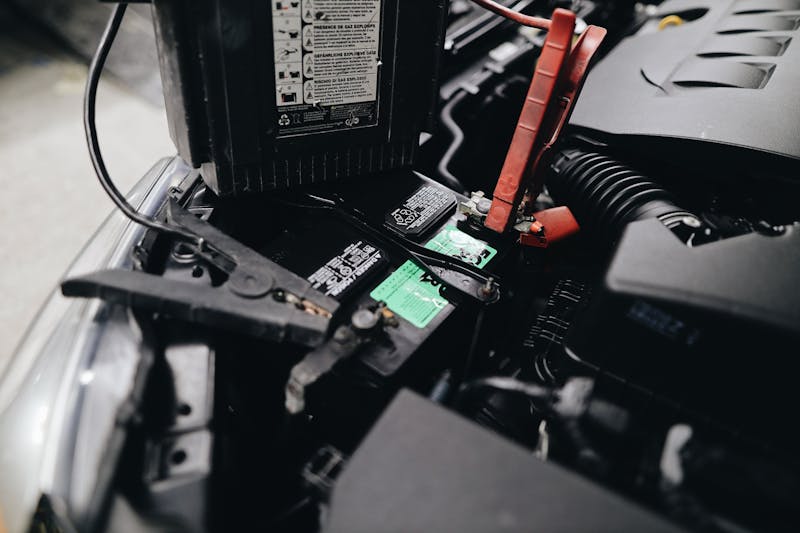
A no-start machine invites a fast fix, but connecting the wrong source voltage can damage control modules, alternators, sensors, wiring, and batteries in seconds. A reversed connection can create an arc or battery explosion. The safe decision begins before any clamp is attached: prove whether the machine is 12 volts or 24 volts and find the approved connection point in its exact operator manual.
The number of batteries is not enough. Two 12V batteries can be connected in series to supply 24V or in parallel to supply 12V with additional capacity. Modified machines and replacement cables make visual assumptions even less reliable.
Urgent go-or-stop decision
| Check | Continue only when | Stop when |
|---|---|---|
| System voltage | Manual and machine identification agree | Voltage is unknown or labels conflict |
| Batteries | Correct type, secure, intact, and not frozen | Case is cracked, swollen, leaking, hot, or possibly frozen |
| Approved connection | Manual identifies jump posts or receptacle | The intended point is improvised, damaged, or unclear |
| Booster or source | Output voltage and application match the machine | Voltage is guessed or a series/parallel workaround is proposed |
| Cables and connectors | Rated, undamaged, clean, and compatible | Insulation, clamps, pins, or receptacle is damaged |
| Polarity | Clearly identified at every approved point | Positive and negative cannot be positively confirmed |
| Environment | Ventilated and clear of ignition sources | Fuel leak, explosive atmosphere, or uncontrolled arcing risk exists |
If any stop condition applies, isolate the machine and call a qualified technician. A schedule delay is cheaper than an electrical-system replacement or battery injury.
Confirm system voltage from authoritative information
Use the operator manual matched to the machine serial number. The electrical-system specification, battery section, and booster-battery procedure should agree. The John Deere operator-manual index is an example of manufacturer documentation that routes operators to model-specific procedures.
Then compare the manual with durable machine information such as:
- Electrical-system or battery-compartment labels
- Approved jump-start receptacle marking
- Starter, alternator, or battery specification where the manual directs inspection
- Fleet records for the exact PIN or serial number
Do not rely on paint-pen notes, battery count, clamp color alone, or what a similar machine used. If wiring has been modified or the labels disagree, stop and have the system traced by a qualified technician with the batteries safely isolated.
Understand series and parallel banks without reconfiguring them
In a typical series bank, the batteries’ voltages add while the amp-hour capacity remains comparable to one battery. Two matched 12V batteries may therefore serve a 24V system.
In a typical parallel bank, voltage remains the same while available capacity increases. Two matched 12V batteries may therefore serve a 12V system.
This explains why counting batteries does not identify voltage. It is not permission to move cables. Never improvise series or parallel booster connections, disconnect the midpoint, or attempt to jump one battery in a bank unless the exact OEM procedure expressly requires it. Unequal charging, arcing, module damage, and battery failure can result.
For routine condition checks, use the inspection and charging practices in our heavy-equipment battery maintenance guide.
Use approved jump posts or receptacles
Many machines provide remote positive and negative posts or a keyed jump-start receptacle. These points keep connections away from the battery gas zone, control cable routing, and provide a connection suited to the machine design.
Caterpillar’s parts catalog shows that jump-start equipment is application-specific. Its 342-3113 jump-start cable is identified for compatible machine applications, while the 2G-1830 starting receptacle is a distinct machine component. A product page does not make either item suitable for an unlisted machine; verify compatibility through the machine manual and dealer.
Do not bypass a receptacle with makeshift wire, use an attachment as an assumed ground, or clamp to a painted, corroded, moving, or fuel-adjacent surface. Use only the points named by the manufacturer.
Match every component to the system
The source, booster pack, charger, cables, plug, clamps, and protective devices must all suit the system voltage and application.
Confirm:
- Nominal output voltage matches the machine
- Booster or charger is approved for the installed battery chemistry and bank arrangement
- Cable insulation, conductor size, length, connectors, and current rating suit the application
- Receptacle keying and pin assignment match
- Source equipment has no damaged case, cable, clamp, plug, or exposed conductor
- The source is positioned and controlled as the OEM procedure requires
A cable advertised for passenger vehicles may not be adequate for a large diesel starter. Likewise, a device with a high peak-amp claim is not automatically suitable for a 24V machine or a particular battery chemistry.
Verify polarity and isolation before connection
Positive and negative must be unambiguous at the approved connection points. Clean enough to read the markings by the safe method in the manual; do not scrape or probe an energized unknown point.
Apply the machine’s parking, transmission, attachment, key, battery-disconnect, and accessory-control conditions exactly as specified. Nearby workers should remain clear, and the area must be ventilated and free of smoking, flame, sparks, and uncontrolled fuel vapor.
Connection order and source-machine operation vary. Follow the exact sequence in the operator manual. Do not use a generic clamp order from a car, another brand, or this article.
Stop for damaged, discharged, or frozen-battery warning signs
Do not attempt a jump start when a battery is:
- Cracked, leaking, swollen, or deformed
- Frozen or possibly frozen
- Unusually hot, hissing, smoking, or strongly odorous
- Loose, unsecured, or connected with damaged cables
- Heavily corroded to the point that safe identification or connection is not possible
A severely discharged battery can freeze at temperatures where a charged battery would not. If state of charge and freeze condition are uncertain, warm and test the battery by the manufacturer-approved process rather than applying a high-current source.
Wear the PPE specified by the battery and machine manufacturers. Batteries can release corrosive electrolyte and explosive gas. Keep the face and body away from the battery tops and connection path.
A successful start is not a successful diagnosis
After the engine starts, follow the manual’s disconnection and stabilization instructions. Watch the display and electrical readings from the normal operator position. Do not assume the alternator is healthy because the engine is running.
The no-start may have resulted from:
- Lights, heaters, telematics, or another parasitic load
- Loose, corroded, high-resistance, or damaged cables
- Mismatched or aged batteries in a bank
- Starter or solenoid fault
- Alternator, regulator, belt, or charging-circuit problem
- Battery disconnect, relay, fuse, wiring, or control-module fault
- Cold oil, fuel, glow-plug, or engine condition that extended cranking
Record the initial symptom, warnings, measured battery condition, source used, and outcome. Have the starting and charging system tested to OEM specifications before returning a repeat offender to service. The diesel engine maintenance guide can help distinguish electrical cranking symptoms from fuel, cold-start, and engine-service conditions.
Add cable, hold-down, battery, disconnect, and warning-lamp checks to the daily pre-operation inspection. Repeated jump starts are a fault pattern, not a maintenance strategy.
The safe decision in one sentence
Prove the voltage, use the specified jump point and rated equipment, verify polarity, and follow the exact OEM sequence—or do not connect. Never guess from battery count, never create an improvised series or parallel source, and never energize a damaged or potentially frozen battery. Once the machine starts, diagnose why it needed outside power before the next shift depends on it.

Ironworks Insider Editorial Team
Independent trade-focused editorial team