Excavator won't swing: Safe diagnostic matrix
Quick answer
When an excavator won't swing, do not assume the swing motor has failed. First confirm that the missing function is upper-structure swing, then record whether the fault affects one or both directions, changes hot versus cold, coincides with weak travel or implements, produces a fault code or noise, or includes leakage, binding, drift, or a brake that may not release. Stop for unsafe movement, leaks, metal debris, binding, or collision risk. A qualified technician should use those observations with the exact model and serial-number service information to select electrical, pilot, hydraulic, brake-release, swing-drive, or bearing checks.
Common questions
- Why won't my excavator swing even though the boom works?
- Normal boom response with missing swing narrows the pattern toward the swing command, interlock, pilot or electrical control, directional valve section, brake-release circuit, swing motor, reduction drive, or slew mechanism. It does not identify which part failed; the next test must come from the exact service manual.
- Does no swing mean the excavator swing motor is bad?
- No. A swing motor is only one part of the command, control, hydraulic, brake, reduction-drive, and slew system. Codes, direction, temperature, other-function behavior, noise, leaks, and model-specific measurements are needed before condemning it.
- What does it mean if an excavator swings one way but not the other?
- A one-direction fault gives a technician a useful directional clue involving the command, electrical or pilot path, valve section, motor circuit, or a mechanical condition. It is not proof of a valve or motor fault and should not be tested by swapping hoses.
- Can I test excavator swing pressure myself?
- Do not improvise a pressure, stall, case-drain, or brake-release test. Test points, rated instruments, oil temperature, engine speed, control state, limits, and isolation steps vary by model and serial number. Use a qualified technician and the exact service procedure.
Source note: Reviewed October 2026 against AEM hydraulic-excavator safety guidance, a Hitachi compact-excavator specification showing separate upper-structure and boom-swing functions, OSHA hazardous-energy guidance, and a WorkSafeBC excavator-swing incident investigation. The exact operator and service manuals control every warning, isolation step, test point, test condition, and limit.
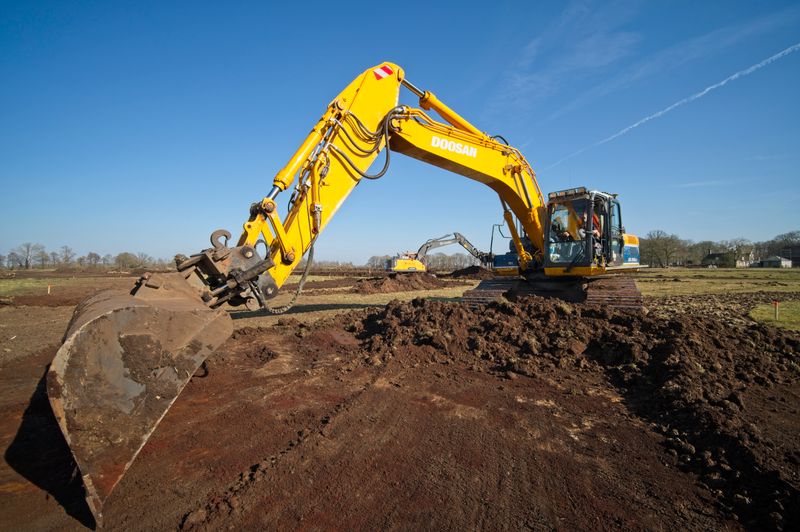
If an excavator won’t swing, do not order a swing motor from that symptom alone. A missing or weak upper-structure swing can begin in the command and interlock path, pilot or electrohydraulic controls, main valve, shared hydraulic supply, swing-brake release circuit, motor, reduction drive, slew gear, bearing, or a physical obstruction.
The safest first job is to preserve the pattern. Direction, temperature, other working functions, fault codes, sound, leakage, and stopping behavior can route the machine to the right model-specific test without guessing at pressures or swapping parts.
First, confirm which function will not move
Equipment terms matter when you request service:
- Upper-structure swing rotates the cab, counterweight, and working equipment relative to the undercarriage. This is the function covered here.
- Boom offset or boom swing moves the boom laterally without rotating the upper structure. Some compact excavators provide this as a separate function.
- Travel drives the tracks or wheels. A travel fault belongs on a different diagnostic path.
For example, Hitachi’s ZX50U-5N and ZX60USB-5N specifications list 360-degree upper-structure rotation and independent boom swing separately. Your machine’s labels and operator manual are the authority.
Excavator no-swing symptom matrix
Use only observations produced during normal, permitted operation. Do not keep cycling an unsafe machine to complete the table.
| What you observe | What the pattern helps separate | Exact-manual handoff |
|---|---|---|
| No swing in either direction; boom, arm, bucket, and travel appear normal | Swing-specific command, interlock, pilot or electrical control, valve section, brake release, motor, or mechanical drive | Retrieve codes and follow the swing-inoperative diagnostic tree for the exact model and serial number |
| No swing plus several slow, weak, or missing functions | Shared engine-speed, hydraulic-supply, control, temperature, fluid, or machine-protection branch | Start with the manual’s multi-function or low-power procedure rather than condemning the swing unit |
| Swings one direction but not the other | Directional command, wiring, pilot signal, valve path, motor circuit, or direction-sensitive mechanical condition | Compare left and right inputs and specified circuit measurements under identical OEM test conditions |
| Normal cold, weak or absent after warm-up | Temperature-dependent control, leakage, brake-release, fluid, supply, or mechanical branch | Record operating time and displayed temperatures; perform only the manual’s temperature-conditioned tests |
| Weak cold, improves as the machine warms | Fluid condition, approved warm-up, restriction, control, or mechanical-resistance branch | Verify fluid identity and service history, then use the OEM cold-condition procedure |
| Swing command produces a whine, laboring sound, or engine response but little movement | The circuit may be commanded and loaded, but the sound does not locate the restriction or failed component | Stop repeated attempts; inspect the hydraulic and mechanical branches using specified instruments and limits |
| Grinding, knocking, binding, or a symptom that repeats at the same rotational position | Mechanical interference, reduction-drive, gear, lubrication, mounting, or slew-bearing branch | Remove the machine from service and perform the manufacturer’s mechanical inspection before further rotation |
| Upper structure moves unexpectedly, drifts, coasts differently, or will not hold as expected | Stopping, holding, brake, control, motor-circuit, or mechanical behavior | Treat as unsafe movement and use the OEM swing-holding and brake diagnostic procedure |
| Active fault code, warning, derate, or changed monitor message | The controller has captured a machine-specific clue | Photograph the full code and operating state before shutdown or clearing; use the corresponding manual procedure |
| Fresh oil leak, damaged hose, wet swing-drive area, metal debris, or overheated odor | External damage, contamination, lubrication, seal, or heat branch | Stop, isolate, and preserve the evidence for leak-source, contamination, and component inspection |
The matrix identifies an evidence path, not a failed part. A brake that appears not to release, for example, could reflect its command, release supply, control hardware, internal mechanism, or another load in the swing train.
Stop operating when swing behavior is unsafe
Take the machine out of service for:
- Unexpected upper-structure movement, drift, changed stopping, or loss of control
- Binding, grinding, heavy knocking, or repeatable mechanical interference
- A collision hazard, unstable setup, or people or property inside the swing radius
- A hydraulic leak, damaged line, smoke, overheating warning, or suspected injection injury risk
- Metal or other abnormal debris in oil, grease, or around the swing drive
- Any warning or shutdown condition named in the operator manual
The Association of Equipment Manufacturers’ Hydraulic Excavator Safety Manual is supplemental guidance, not a replacement for the manufacturer’s manual. AEM also warns operators to keep personnel clear and never swing a load or attachment over anyone.
A WorkSafeBC incident investigation documents how an excavator swung unexpectedly during maintenance when the machine was left running, controls were not locked out, and a worker was inside the swing radius. Keep the exclusion zone clear even when the original complaint is “no swing.”
Safe observations before the service call
Start with the make, full model, serial number, hour meter, installed attachments, and the correct operator manual. Then capture what normal operation has already shown:
- Direction: left, right, or both.
- Temperature: first start, after warm-up, or after a consistent amount of work.
- Other functions: boom, arm, bucket, blade, auxiliary hydraulics, and travel—without deliberately stalling any function.
- Controls and display: exact code, warning, work mode, engine setting, and whether an approved control lock or interlock state has changed.
- Sound and feel: silence, hydraulic whine, engine loading, chatter, knock, grind, vibration, binding, or a changed stop.
- Visible condition: fresh leakage, damaged wiring or hoses, loose guards, abnormal grease or debris, and evidence of contact or obstruction visible from a safe position.
- History: when the fault began, recent service or washing, attachment changes, fluid or filter work, impact, transport, storage, and whether anyone has already disconnected or adjusted anything.
Use the pre-operation inspection checklist to organize exterior observations. If several hydraulic functions are noisy, add the hydraulic pump whining matrix. If the symptom appears with a heat warning, use the excavator hydraulic oil overheating guide as a separate evidence sheet.
Do not reach into the slew area, remove guards, crawl beneath the machine, touch a suspected high-pressure leak, or loosen a hose to look for flow. Do not defeat the swing brake, counterbalance function, control lock, or interlock.
Tests that belong to trained service personnel
A qualified technician may need the correct schematic, diagnostic software, rated instruments, clean test fittings, blocking and isolation equipment, and the model- and serial-specific manual to evaluate:
- Joystick or lever input, switches, sensors, wiring, controller data, and interlocks
- Pilot pressure or electrohydraulic command to the swing valve section
- Specified main-valve, relief, make-up, or anti-cavitation behavior
- Swing-brake command and release sequence
- Swing motor pressure, flow, case drain, and internal leakage where the manual calls for them
- Reduction-drive lubricant, mounting, pinion, ring gear, bearing, and obstruction condition
- Shared pump, priority, engine-speed, fluid-temperature, or protection logic when other functions are affected
There is no universal swing pressure, case-drain limit, brake-release value, stall time, or acceptable bearing movement. Never transfer a value or test sequence from a different model.
OSHA’s control of hazardous energy guidance identifies hydraulic, mechanical, and other stored energy as servicing hazards. Follow the employer’s applicable energy-control procedure and the exact manufacturer instructions; lowering the attachment or moving a cab control is not, by itself, proof that all energy is isolated.
Give the technician a decision-ready handoff
Send one concise report:
Machine: [make, model, serial, hours]. Upper-structure swing is [absent/weak/changed] in [left/right/both] directions. It occurs [cold/hot/always] and began [time/event]. Other functions are [normal/affected, with details]. Display shows [exact code or warning]. Sound or feel is [description], visible condition is [leak/damage/debris/none observed], and recent work was [details]. The machine is out of service because [safety trigger, if any].
Attach safe photos or video, the code screen, and service records. Ask the technician to state which manual test was performed, under what conditions, what was measured, what specification applied, and how the result supports the repair.
If travel is also weak, route that symptom through the excavator final-drive troubleshooting matrix so track, shared-hydraulic, travel-motor, and gearbox evidence stays separate. For contamination, fluid, filter, and hose history, use the hydraulic-system maintenance guide.
The fastest safe diagnosis is a precise symptom record paired with the exact service procedure. Preserve the evidence, control the swing zone, and let measured results—not the phrase “won’t swing”—decide what gets repaired.

Ironworks Insider Editorial Team
Independent trade-focused editorial team