Telehandler Buying Guide: How to Choose the Right Telescopic Handler
Quick answer
Telehandler selection should start with lift height, rated capacity at reach, ground conditions, attachment use, visibility, stabilizers, transport limits, and operator training. The headline capacity is not the capacity at full reach.
Common questions
- Why is a telehandler load chart important?
- Capacity changes with boom angle, reach, attachment, and machine configuration. The load chart shows what the machine can safely handle in the actual lift position.
- What attachments change telehandler selection?
- Forks, buckets, truss booms, work platforms, and specialty attachments can change capacity, stability, and training needs. Choose the machine and attachment as a system.
Source note: Reviewed July 2026 against the article guidance and common heavy-equipment practice; manufacturer manuals, site plans, OSHA rules, and competent-person direction control field work.
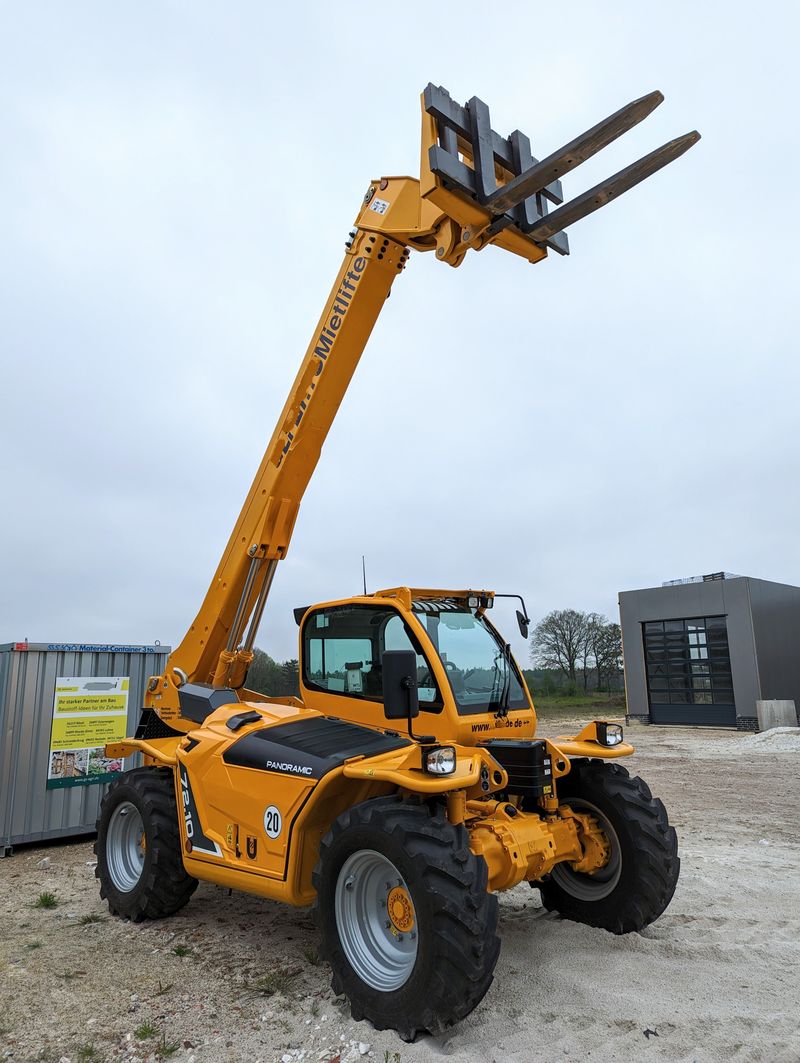
No other piece of construction equipment does what a telehandler does. With a telescoping boom that extends forward and upward, a telehandler can place a pallet of roofing materials on a third-floor deck, load a 6,000 lb steel beam into position, and then swap to a bucket to clean up debris — all before lunch. It’s the Swiss Army knife of the job site, and for many contractors it has replaced forklifts, rough-terrain cranes, and even small aerial platforms.
But telehandlers range from compact 5,000 lb-capacity units that fit on residential lots to massive 55-foot-reach machines designed for steel erection and large-scale commercial construction. Buying the wrong machine — wrong reach, wrong capacity, wrong brand support — is an expensive mistake.
This guide covers everything you need to choose the right telehandler for your operation.
What Telehandlers Are Used For
A telescopic handler (telehandler, telescopic forklift, or reach forklift) is a four-wheel-drive rough-terrain machine with a telescoping boom that can carry a variety of attachment heads. Unlike a conventional forklift, the boom extends outward and upward, giving the machine reach that a vertical-mast forklift can never achieve.
Common applications include:
- Material placement at height — delivering roofing, wall panels, masonry, and lumber to upper floors
- Steel and structural placement — positioning beams, columns, and pre-cast elements with precision
- Concrete formwork and precast — moving heavy form components and placing precast panels
- Agriculture — moving large round bales, feed, and silage in a format that fits tight farm operations
- Demolition support — removing debris from elevated areas and loading trucks
- Aerial access — with a work platform attachment, providing personnel lift at height
The telehandler’s key advantages over alternatives are reach combined with mobility. A rough-terrain forklift can only lift directly up. A crane has more capacity but costs more and requires a certified operator. A telehandler splits the difference, providing meaningful reach and lift capacity in a machine one operator can drive across a muddy site, position quickly, and reattach with a different head in minutes.
Key Specifications Explained
Lift Capacity
Rated in pounds or kilograms, this is the load the machine can safely carry — but the rating is always at a specific load center distance and lift height. A telehandler rated at 8,000 lb at ground level with the boom retracted may have far less capacity at another point in its operating envelope. Before comparing machines, use our telehandler load chart guide to document the exact attachment, load center, height, reach, and configuration instead of relying on the headline capacity number.
Maximum Lift Height
How high the forks or attachment can reach at full boom extension. Heights range from around 19 feet on compact models to 58+ feet on high-reach models. Match this to your tallest application — a machine that can’t reach the top of your structure is useless for that task.
Maximum Forward Reach
The horizontal distance from the front axle to the load center at maximum extension. This determines whether you can pick from one position and place in another without repositioning the machine. Forward reach matters enormously on congested sites where repositioning costs time.
Load Moment
The product of load weight and load center distance. Every telehandler has a maximum load moment — exceeding it tips the machine. Modern telehandlers use load moment indicators (LMI) or stability control systems that warn the operator and can limit boom functions when approaching the rated moment. Verify this is present and functioning on any machine you evaluate.
Drive and Steer Configuration
Most telehandlers offer three-mode steering: front-wheel, all-wheel (crab steer), and two-wheel rear. All-wheel (crab) steer allows the rear wheels to track exactly behind the fronts, critical for working in tight corridors or along building faces without scuffing finished surfaces. Two-speed hydrostatic or powershift transmissions are standard on most machines; higher road speed matters for operators traveling long distances between placements.
Hydraulic Flow and Pressure
Attachment performance depends on auxiliary hydraulic capacity. Verify the machine’s auxiliary flow (gpm) and pressure (psi) are compatible with the attachments you plan to run — particularly hydraulic work platforms, sweeper buckets, and grapples.
Size Classes: Matching the Machine to the Job
| Class | Lift Capacity | Max Lift Height | Typical Application |
|---|---|---|---|
| Compact | Under 6,000 lb | 15–22 ft | Residential construction, landscaping, agriculture |
| Mid-Range | 6,000–10,000 lb | 20–36 ft | General contracting, commercial construction, roofing |
| High-Reach | 10,000–16,000 lb | 36–58 ft | Multi-story commercial, steel erection, tilt-up |
| Heavy-Lift | 16,000 lb+ | 40–58 ft | Industrial, precast, heavy civil |
For most general contractors doing two-to-four story commercial or residential work, a mid-range machine with 8,000–10,000 lb capacity and 36–42 feet of lift height hits the sweet spot. It handles 90% of material handling tasks, transports on a standard lowboy, and represents a manageable purchase price and operating cost.
If your work frequently involves placing materials above the fourth floor or handling structural steel, move up to a high-reach class machine and accept the higher purchase price, transport requirements, and operating weight.
Top Brands in the Telehandler Market
JLG
JLG is among the most widely used telehandler brands in North America, particularly in the rental fleet segment where their machines make up a substantial share of inventory at United Rentals, Sunbelt, and BlueLine. The JLG 1055, 1255, and 1644 are workhorses found on commercial jobsites across the continent. JLG machines are known for reliable performance, strong dealer support, and good parts availability. Their SkyTrak line covers compact and mid-range applications well.
Best for: Contractors who value broad rental-market familiarity, resale liquidity, and strong dealer networks.
Genie
Genie (a Terex brand) competes closely with JLG in the rental and commercial segments. The Genie GTH-844, GTH-1056, and GTH-5519 cover a wide range from general contracting to high-reach applications. Genie machines are well-regarded for operator ergonomics and cab comfort, and their SX-180 high-reach model reaches 180 feet in boom lift configuration. Dealer coverage is broad in major markets.
Best for: Contractors prioritizing operator comfort and access to a brand common in rental fleets.
Manitou
Manitou is the French-origin brand that arguably invented the modern telehandler. Their MLT and MT series machines are particularly dominant in agricultural applications and are gaining ground in construction. Manitou machines are known for robust engineering, excellent reach-to-capacity ratios, and strong off-road capability. The Manitou MRT series (rotating telehandlers) offer 360-degree rotation and can substitute for small rough-terrain cranes on many jobsites.
Best for: Agricultural operations and contractors who want rotating telehandler capability or European-market familiarity.
JCB
JCB’s Loadall series is arguably the most recognized telehandler brand globally. JCB claims to have invented the telehandler, and the Loadall line — the JCB 507-42, 510-56, 540-170 — reflects decades of refinement. JCB machines are known for strong build quality, excellent cab design, and smooth hydraulic response. They are common in UK and European markets and have solid but less dominant U.S. coverage. JCB’s LiveLink telematics is competitive.
Best for: Contractors who want a premium-built machine and have access to strong JCB dealer support in their region.
Caterpillar (CAT)
CAT’s telehandler line — produced in partnership with and incorporating technology from Manitou — includes the TH357D, TH408D, TH514D, and TH514C series. The CAT brand brings its legendary dealer network and parts availability to the segment. For contractors deeply embedded in the CAT ecosystem with an existing dealer relationship, a CAT telehandler fits naturally into a mixed fleet for service and financing purposes.
Best for: Contractors already in the CAT ecosystem who want single-brand dealer support and financing.
Skyjack
Skyjack focuses on the compact and mid-range telehandler segment with machines that are straightforward, operator-friendly, and competitively priced. The SJ843TH and SJ1044TH are solid performers in the general contracting segment. Skyjack’s focus on simplicity (fewer electronic complications) appeals to contractors who prefer mechanically simpler machines with lower maintenance overhead.
Best for: Contractors who value simplicity, lower purchase price, and ease of maintenance over premium features.
Attachments: What Makes Telehandlers Versatile
The telehandler’s attachment versatility is what separates it from a rough-terrain forklift. Most machines use a universal quick-attach carriage (often ISO hook or pin-type) that allows rapid changeovers.
Key attachments to consider:
- Pallet forks — the standard configuration; always included at purchase
- Bucket — for moving bulk materials like gravel, topsoil, and sand
- Work platform (man basket) — provides aerial access for personnel; requires load chart verification
- Grapple — for handling irregular loads like brush, debris, or pipe
- Bale clamp — essential in agricultural applications
- Truss boom (jib) — extends reach further for precision placement
- Hook and shackle — for rigging and lifting operations
Confirm your planned attachments are hydraulically and mechanically compatible with the machine you’re considering. Attachment compatibility varies by carriage standard and auxiliary hydraulic specification.
New vs. Used Telehandlers
New machines offer manufacturer warranties (typically 2–3 years), the latest stability control and telematics technology, dealer financing, and no maintenance history uncertainty. Expect to pay $60,000–$180,000+ depending on capacity and lift height.
Used machines offer significant savings — a well-maintained mid-range telehandler with 2,000–4,000 hours can sell at 50–65% of new price. Key inspection points:
- Boom wear and telescope cylinder condition — check for bent sections, worn wear pads, and seeping cylinder rods along the full extension range
- Frame cracks and welds — telehandlers work under dynamic load moments; inspect the frame around the boom pivot and outrigger mounting points carefully
- Axle and drivetrain condition — four-wheel drive components are expensive; listen for differential noise and check for leaks
- Stability control systems — verify the load moment indicator and any electronic stability systems are operational; these are safety-critical
- Carriage and tilt cylinder condition — check fork carriage wear and the condition of the tilt and side-shift hydraulic cylinders
Have a qualified telehandler technician perform a pre-purchase inspection before committing to a used machine. The cost is minimal relative to the purchase price and potential repair exposure.
Rental vs. Buying
Telehandlers are among the most-rented pieces of construction equipment precisely because project needs vary so much.
Rent when:
- The telehandler is needed for a single project phase (framing, roofing, structural placement)
- Your annual utilization is fewer than 400–500 hours per year
- The required capacity or lift height doesn’t match your owned fleet
- You need a high-reach or rotating telehandler for one project
Buy when:
- Telehandler work is continuous throughout the year and central to your business
- Rental availability in your market is unreliable during peak construction season
- Owning gives you scheduling flexibility that rental can’t provide
- You can amortize the purchase over multiple years of consistent use
If you’re on the fence, run the numbers: compare annual rental cost (typically $3,500–$8,000/month for mid-range machines) against ownership cost including purchase price, interest, insurance, maintenance, and projected resale value. The breakeven is usually somewhere around 600–700 hours of annual use.
Transport Considerations
Most mid-range telehandlers weigh 16,000–25,000 lb in operating configuration. This typically requires a 35-ton-rated lowboy or flatbed and a CDL driver for transport. Factor transport into your operating cost model — a telehandler that has to move frequently between sites adds meaningful cost per project.
Compact telehandlers under 12,000 lb can sometimes be transported on a heavy-duty gooseneck trailer without a CDL, but verify weight limits and your state’s regulations.
Making the Final Decision
Before signing a purchase order or rental agreement:
-
Define your most demanding application. Identify the heaviest load you’ll regularly lift and the highest point you need to reach. Size your machine so you’re operating comfortably within its rated capacity at that application — not at the edge of the load chart.
-
Demo the machine on your site conditions. Maneuverability on soft ground, cab visibility, and boom control response vary significantly between brands. Run the machine through actual job conditions before committing.
-
Evaluate your local dealer’s service capacity. A telehandler down during framing or structural steel placement can shut a project down. The dealer who can put a technician on-site within hours, or swap a rental machine in overnight, is worth paying a premium for.
-
Check attachment compatibility before purchase. If you plan to run a work platform, confirm the machine’s stability control system supports it and that the carriage matches. Carriage adapters exist but add cost and complication.
The right telehandler is the one that reaches your highest placement, lifts your heaviest load, fits your site conditions, and is backed by a dealer who can keep it running. Brand loyalty matters less than that equation.

Ironworks Insider Editorial Team
Independent trade-focused editorial team