Vertical lift vs. radial lift skid steer: job-match guide
Quick answer
Choose by the height where the attachment must work. A radial-lift skid steer generally provides useful forward reach through the middle of its lift arc for digging, backfilling, and lower-sided loading. A vertical-lift skid steer generally favors hinge-pin height and reach near full lift for high-sided trucks and elevated placement. The label does not determine safe capacity: compare exact-model ratings, geometry, attachment and load center, configuration, terrain, visibility, transport, service access, and dealer support.
Common questions
- Is vertical lift better than radial lift on a skid steer?
- Neither is universally better. Vertical lift is often a stronger shortlist for frequent work near full lift, while radial lift often suits digging, grading, backfilling, and loading at lower or middle heights. Compare the exact machine at the height your job actually uses.
- Does a vertical-lift skid steer have more lifting capacity?
- Some vertical-lift models publish a higher rated operating capacity than comparable radial models, but the lift-path label does not create a safe capacity. Machine size, weight, configuration, attachment, load center, rating basis, and operating conditions all matter.
- Is radial lift better for digging?
- Radial lift is commonly matched to digging, grading, prying, backfilling, and other lower-height work because of its simpler arc and useful midrange reach. Breakout force, visibility, tires, hydraulics, controls, and attachment fit still need exact-model comparison.
- What should I compare besides skid steer lift path?
- Compare ROC and its rating basis, hinge-pin height, dump clearance, reach and angle at your working height, attachment approval, load center, visibility, operating and transport weight, dimensions, maintenance access, controls, hydraulics, and local parts and service support.
Source note: Current Bobcat model pages, Bobcat's loader buyer guide and official manual locator, and WorkSafe Victoria skid-steer guidance were reviewed on October 26, 2026. The Bobcat S510/S530 figures are a document-reading example, not a controlled test or proof that lift path caused every difference. Specifications, configurations, rating methods, and availability vary by model and market.
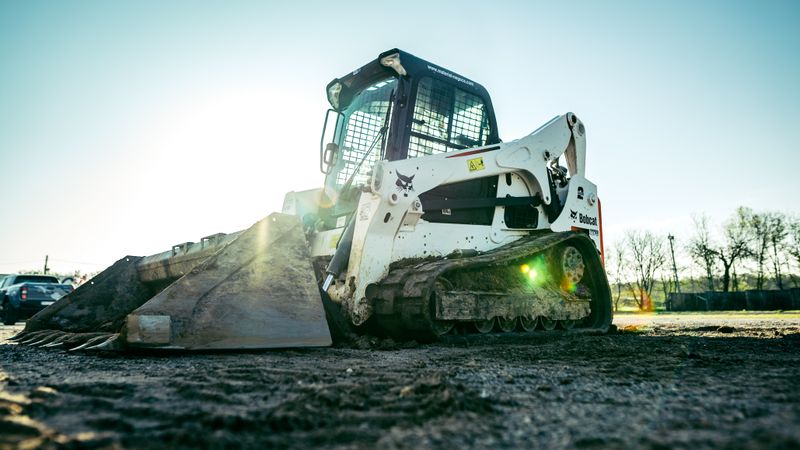
For work mostly at or below truck-bed height, start your shortlist with a radial-lift skid steer. For repeated loading or placement near full lift, start with vertical lift. Then compare exact models at the height your attachment actually works. “Radial” and “vertical” describe the lift path; neither label proves safe capacity, stability, or job fit.
Decision boundary: Use the exact machine rating plate, operator manual, attachment instructions, and manufacturer-approved limits. The load, load center, carrier configuration, ground, slope, travel path, and operator rules still control. Never turn tipping load, breakout force, or lift-path type into a homemade capacity limit.
Radial vs. vertical lift at a glance
| Your repeated task | Start with | Evidence to request before choosing |
|---|---|---|
| Digging, grading, backfilling, or loading a flatbed | Radial lift | Reach and visibility at the real middle working height; breakout performance with the specified bucket |
| Loading a high-sided truck or hopper | Vertical lift | Hinge-pin height, dump clearance, dump reach, and dump angle with the actual bucket |
| Placing pallets or materials at elevation | Vertical lift | Approved carrier/fork combination, load-center limit, ROC basis, and placement visibility |
| Mixed work with no dominant lift height | Either | A jobsite demonstration using representative attachments, heights, clearances, and loads |
| Tight trailer, doorway, or weight limit | Either | Configured width, height, length, operating weight, attachment weight, and transport plan |
This is a shortlisting rule, not an operating instruction. A radial model can load trucks, and a vertical model can dig. The best purchase is the machine whose documented geometry, configuration, and support match the work you perform most often.
What the two lift paths change
A radial-lift linkage moves the coupler through an arc. Current Bobcat loader-selection guidance associates that path with useful reach at middle heights for work such as backfilling, clearing walls, and loading flatbeds.
A vertical-lift mechanism uses additional linkage to keep the coupler path more upright through much of the cycle and favor reach near full height. “Vertical” does not mean perfectly straight on every model. Ask for the exact lift-path chart or measure a demonstration at the height that matters.
Lift geometry also affects sightlines and service points. Do not assume every radial machine has better visibility or every vertical machine costs more to maintain. Cab design, cameras, windows, service doors, and grease-point access vary by model.
Exact-model example: Bobcat S510 vs. S530
The current European Bobcat pages provide a useful paired example. The S510 is radial lift, while the S530 is vertical lift. Both pages list a 41-kW engine, the same standard-bucket width, the same wheelbase, and ISO 14397-1 ROC and tipping-load figures.
| Published specification | S510 radial lift | S530 vertical lift |
|---|---|---|
| Rated operating capacity | 851 kg | 911 kg |
| Tipping load | 1,703 kg | 1,823 kg |
| Operating weight | 2,816 kg | 2,952 kg |
| Hinge-pin height | 2,908 mm | 3,023 mm |
| Dump height, standard bucket | 2,205 mm | 2,319 mm |
| Dump reach at maximum height | 432 mm | 828 mm |
| Dump angle at maximum height | 42 degrees | 42 degrees |
The vertical-lift S530 publishes more height and full-height reach, but it is also a different, heavier model with a different lift mechanism. This table is not a controlled experiment, and the capacity difference cannot be credited to lift path alone. It shows why a buyer should keep geometry, rating basis, configuration, and weight together instead of comparing one headline number.
If capacity language is unfamiliar, read tipping load vs. rated operating capacity before using a spec sheet. Tipping load is not a working target, and ROC does not approve every attachment, height, surface, or load center.
Compare reach at the actual working height
“Maximum reach” is incomplete unless the document says where it is measured. Record the target height and horizontal clearance for each repeated task:
- Measure the receiving edge: flatbed deck, truck side, hopper lip, wall, or placement shelf.
- Record where the bucket cutting edge, fork heel, or load must finish—not just the hinge pin.
- Add the specified attachment’s dimensions and approved rollback or dump range.
- Request reach, clearance, and angle at that height from the exact model document.
- Demonstrate the task on firm, level ground with the dealer or rental provider under controlled conditions.
Hinge-pin height is a reference point, not usable dump clearance by itself. Bucket profile and dump angle determine whether material clears a side. Fork length, pallet depth, and load center change the placement problem again.
Keep attachment and load center in the comparison
Two equal-weight loads can affect the machine differently when one sits farther forward. Pallet forks, buckets, grapples, adapters, couplers, and rigging add mass and move the combined center of gravity.
Do not subtract attachment weight from ROC and call the result safe unless the manufacturer provides that method for the exact setup. Ask the dealer for written compatibility and a controlling rating for the carrier, attachment, options, and load center. The skid steer attachment compatibility checklist covers mount, hydraulic, electrical, guarding, weight, and carrier approval.
Powered tools add a separate decision. Lift path does not tell you whether a planer, mulcher, or snowblower has the required flow, pressure, case drain, cooling, and controls. Use the standard-flow vs. high-flow worksheet for that check.
Shortlist worksheet
Complete one column per exact machine. A blank critical field means the comparison is not ready.
| Decision field | What to record |
|---|---|
| Repeated job | Material, verified weight, pickup height, work height, discharge height, cycles per day |
| Geometry | Lift path, lift-path chart, hinge-pin height, dump clearance, reach and angle at working height |
| Rating basis | ROC, tipping load, test standard, market, tires, bucket, coupler, cab, counterweight, operator basis |
| Attachment and load | Make/model, approval, mass, capacity, dimensions, load center, hydraulic/electrical needs |
| Site | Ground support, measured slope, edges, holes, overhead clearance, exclusion zone, travel route |
| Operator view | Cutting edge, fork tips, load, truck side, rear corners, camera view at each work stage |
| Transport | Configured operating weight, attachment weight, width, height, length, trailer payload and axle limits |
| Ownership | Daily checks, service access with arms lowered, grease points, wear joints, parts lead time, dealer response |
| Demonstration result | Exact machine and attachment tested, representative height/load, operator feedback, unresolved limits |
Do not mix skid steer and compact track loader ratings in one row without preserving the different machine class and rating basis. If underfoot conditions drive the purchase, compare skid steer vs. compact track loader separately. Confirm the configured haul plan with the equipment transport guide.
Visibility, maintenance, and dealer support can decide the tie
Operate each shortlisted machine from the normal seated position. Check the attachment edge, front corners, raised load, receiving edge, rear quarters, and camera view. A brochure’s visibility claim cannot substitute for the actual operator, attachment, and task.
For maintenance, identify daily check points, lift-arm support requirements, grease locations, hose routing, cab-tilt procedure, and access with the arms fully lowered. Bobcat’s official manual service says operation and maintenance manuals provide safe operation and maintenance instructions; obtain the manual matching the model and serial number before delivery.
Then compare dealer travel time, field-service coverage, parts stock, attachment support, training, and loaner or rental options. Our Bobcat vs. Kubota vs. Cat comparison helps structure that broader brand and support decision without treating lift path as the whole purchase.
Useful next step
Choose your two most frequent working heights and complete the worksheet for no more than three exact machines. Send the gaps to each dealer in the same format, then schedule demonstrations with representative attachments. Ask the dealer to document any approved counterweight, attachment, load-center, and transport changes in the final configuration.
Before the machine goes to work, train operators on the exact manual, pre-start checks, restraints, interlocks, exclusion zones, load handling, ground, and slope rules. WorkSafe Victoria’s skid-steer guidance emphasizes model-specific instruction, functioning safety devices, and approved support when raised arms must be serviced.
Sources and scope
Sources reviewed October 26, 2026, Australia/Melbourne date:
- Bobcat compact loader buyer’s guide: key selection factors
- Bobcat S510 radial-lift specifications
- Bobcat S530 vertical-lift specifications
- Bobcat operation and maintenance manual locator
- WorkSafe Victoria: controlling risks from skid-steer loaders
Specifications and availability can change. Ironworks Insider did not test these machines. Confirm the current local model page, build sheet, rating plate, serial-number-specific manual, attachment documents, site rules, and legal requirements before buying, renting, transporting, or operating a loader.

Ironworks Insider Editorial Team
Independent trade-focused editorial team